

FEDERAL COURT OF AUSTRALIA
Seafish Tasmania Pelagic Pty Ltd v Burke, Minister for Sustainability, Environment, Water, Population and Communities (No 2) [2014] FCA 117
| IN THE FEDERAL COURT OF AUSTRALIA | |
| DATE OF ORDER: | |
| WHERE MADE: |
THE COURT ORDERS THAT:
1. The application is dismissed.
2. The applicants are to pay the respondents’ costs of and incidental to the proceeding, including reserved costs, to be taxed if not agreed.
Note: Entry of orders is dealt with in Rule 39.32 of the Federal Court Rules 2011.
| QUEENSLAND DISTRICT REGISTRY | |
| GENERAL DIVISION | QUD 52 of 2013 |
| BETWEEN: | SEAFISH TASMANIA PELAGIC PTY LTD ACN 157 913 776 First Applicant SEAFISH TASMANIA PTY LTD ACN 097 802 572 Second Applicant |
| AND: | THE MINISTER FOR SUSTAINABILITY, ENVIRONMENT, WATER, POPULATION AND COMMUNITIES FOR THE COMMONWEALTH OF AUSTRALIA First Respondent THE MINISTER FOR AGRICULTURE FISHERIES AND FORESTRY FOR THE COMMONWEALTH OF AUSTRALIA Second Respondent THE COMMONWEALTH OF AUSTRALIA Third Respondent |
| JUDGE: | LOGAN J |
| DATE: | 21 FEBRUARY 2014 |
| PLACE: | BRISBANE |
REASONS FOR JUDGMENT
1 In maritime circles, it is considered unlucky to change the name of a ship after she has first sailed: Jonathan Eyers, Don't Shoot the Albatross!: Nautical Myths and Superstitions, Adlard Coles Nautical (an imprint of Bloomsbury Publishing), 2011, Extract: http://www.jonathaneyers.com/nautical_sailing_superstitions.html (Accessed 5 February 2014). The vessel now known as the FV Abel Tasman (Abel Tasman) has, in her lifetime, undergone several such changes of name. Some who come to read what follows might consider that there is substance in the maritime superstition.
2 The Abel Tasman is a 143-metres-long, mid-water, factory freezer trawler. On 30 August 2012, she arrived at Port Lincoln, South Australia after a voyage from The Netherlands which commenced on 4 July 2012. A comprehensive refit in The Netherlands had preceded that voyage.
3 Seafish Tasmania Pelagic Pty Ltd (Seafish Tasmania) became the owner and operator of the vessel in mid-August 2012. She was then named FV Margiris (not her original name). Seafish Tasmania renamed her the Abel Tasman after the great, 17th century, Dutch explorer of Australasian waters of that same name. The purpose of bringing the Abel Tasman to Australia was so that she could be deployed to fish for, process and freeze fish within the limits of Seafish Tasmania’s Australian quota of Jack Mackerel, Blue Mackerel and Redbait. Seafish Tasmania believed that it would be lawfully entitled to do this in Australia’s “Small Pelagic Fishery” (SPF).
4 At the time when the Abel Tasman arrived in Australia, Seafish Tasmania had reasonable grounds for believing that it would be able lawfully to deploy that vessel in the SPF to target, fish and process the quota fish species mentioned. As subsequent events transpired, its experience proved otherwise. To understand the issues in this judicial review proceeding and how they arise, it is necessary first to chart those events and to descend into some detail in relation to matters of law and fact touching upon Australian fisheries administration and management. The occurrence of the events which I relate, as opposed to their consequences in law, is not in dispute.
5 The SPF is one of 18 Commonwealth fisheries. The day-to-day management of the SPF reposes in the Australian Fisheries Management Authority (AFMA). AFMA is a statutory corporation established by the Fisheries Administration Act 1991 (Cth). One of AFMA’s functions is to manage fisheries in accordance with management plans made under the Fisheries Management Act 1991 (Cth) (Fisheries Management Act).
6 One such management plan was the Small Pelagic Fishery Management Plan 2009 (Cth) (FM Plan 2009), determined on 2 November 2009. Pursuant to section 3 of the FM Plan 2009, the boundaries of the SPF extend from just above the Queensland/New South Wales border, typically outside three nautical miles, around southern Australia to a line at latitude 31 south (near Lancelin, north of Perth). A map of the SPF and its sub-areas is in evidence:
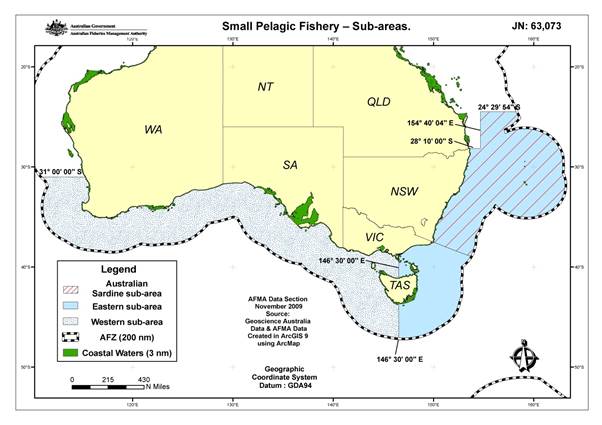
Note: In the above legend, “AFZ” refers to the Australian Fishing Zone and “MN” refers to a nautical mile.
7 Under the SPF Plan 2009, “mid-water trawling” is a permissible method of fishing in the SPF. Mid-water trawling is a method of fishing which involves towing a net behind a boat(s) through the ocean at a depth below the ocean surface, but higher in the water column than the bottom of the ocean. This is so as to target those fish species which are categorised as pelagic fish. Pelagic fish tend to be highly mobile and fast-moving fish, forming schools throughout the water column as opposed to demersal fish species, which are closely associated with the seafloor.
8 As with all Commonwealth fisheries, gaining access to fish in the SPF requires a successful application to be made to AFMA for the relevant fishing concessions. In essence, a fishing concession grants to a successful applicant ‘shares’ in a fisheries resource. Concessions can be given in the form of Statutory Fishing Rights or fishing permits. The SPF has operated under a system of Statutory Fishing Rights since May 2012.
9 A combination of both input controls (eg the number of fishing vessels) and output controls (eg the number of fish caught) govern access to fisheries resources. Output controls are monitored by scientific researchers in the employ of AFMA closely and regularly. In large part, the annually revised Total Allowable Catch (TAC) determines output controls. This is because AFMA apportions to concession holders the sustainable TAC of a fishery in line with the number of individually transferable quota catch units held by a concession holder.
10 On 20 September 2012, AFMA allowed and registered the nomination made by Seafish Tasmania for the Quota, the Scalefish Statutory Fishing Rights and a leased Statutory Fishing Right for the Great Australian Bight Fishery which permitted fishing activities allowed under those statutory fishing rights. On the very same day, however, the Abel Tasman was prohibited from operating in Australia's SPF by virtue of an interim declaration made pursuant to amendments made by the Environment Protection and Biodiversity Conservation Amendment (Declared Commercial Fishing Activities) Act 2012 (Cth) (the Amendment Act) to the Environment Protection and Biodiversity Conservation Act 1999 (Cth) (EPBC Act) by the then Minister for Sustainability, Environment, Water, Population and Communities, the Hon. Tony Burke (the Environment Minister) in consultation with the then Minister for Agriculture, Fisheries and Forestry, Senator the Hon. Joe Ludwig (the Fisheries Minister). The legislative foundation for the ministerial declaration is to be found in the newly inserted Ch 5B of the EPBC Act, which came into effect on the day the Amendment Act received the Royal Assent, 19 September 2012.
11 The lawfulness of these declarations has become the principal focus of these judicial review proceedings.
12 Pursuant to the EPBC Act, as newly amended, an interim declaration was made by the Environment Minister on 20 September 2012 (first interim declaration). Following a statutorily mandated consultation period, a final declaration was made under Ch 5B of the EPBC Act on 19 November 2012 (final declaration). These declarations had the effect of prohibiting a commercial fishing activity that:
(a) is in the Small Pelagic Fishery;
(b) uses the mid-water trawl method; and
(c) uses a vessel that is greater than 130 metres in length, has an on-board processing facility and has storage capacity for fish or fish products in excess of 2,000 tonnes.
13 On 25 February 2013, the Environment Minister made the Interim (Small Pelagic Fishery) Declaration No. 2 (2013) (second interim declaration) under Ch 5B of the EPBC Act, which prevented the Seafish Tasmania from using the Abel Tasman for an alternatively proposed use, namely as a ‘floating freezer’ for other motherships. The second final declaration was made on 26 April 2013 – Final (Small Pelagic Fishery) Declaration No 2 (2013) (‘second final declaration’).
14 Seafish Tasmania filed judicial review proceedings on 4 February 2013 against the Environment Minister, the Fisheries Minister and the Commonwealth of Australia.
15 On 4 June 2013, Seafish Tasmania sought to file a Second Further Amended Statement of Claim and a Second Further Amended Originating Application in order to impugn the decision of the Environment Minister to make the second final declaration. That application was dismissed, but leave was granted to it to file a new originating application dealing with the second final declaration at the commencement of the hearing. Such an application was filed by leave on the first day of the hearing (25 June 2013). The hearing of that application was adjourned to the date fixed for judgment in these proceedings (QUD 52 of 2013). The occasion for that was agreement between the parties that the outcome of the proceedings concerning the three previous declarations will, for all practical purposes, dictate the outcome in respect of that fourth declaration.
16 It is first three ministerial declarations under Ch 5B, Pt 15B of the EPBC Act which Seafish Tasmania seeks to impugn in this proceeding. As pleaded, there is also an endeavour by Seafish Tasmania to have quashed the anterior step to the making of such declarations constituted in each instance by the Fisheries Minister’s agreement with the Environment Minister that there existed uncertainty as to the environmental impact of the proposed commercial fishing activity and that prohibition was “appropriate”.
17 The proceedings have been instituted under both s 39B of the Judiciary Act 1903 (Cth) (Judiciary Act) and the Administrative Decisions (Judicial Review) Act 1977 (Cth) (ADJR Act). Reliance by Seafish Tasmania on the latter is the subject of an objection to competency made by the respondent Ministers. The basis for that is the proposition that each of the three ministerial declarations is legislative rather than administrative in character such that neither the decisions to make the declarations themselves nor any anterior step such as the reaching of Ministerial agreement is amenable to review under the ADJR Act. Sensibly in the circumstances of this case, the parties agreed that the convenient course to take was to determine that objection in conjunction with the other issues raised in the proceedings rather than as a preliminary point.
18 As to an objection to competency, the following observations with respect to practice and procedure should be made. Rule 31.05 of the Federal Court Rules 2011 permits a respondent to an application under the ADJR Act to object to the competency of that application within the time and in the form of the objection prescribed. The objection must though go to the competency of the application, not to but one of its jurisdictional foundations if there is more than one: see, by analogy, Belton v General Motors Holden's Ltd (No 1) (1984) 58 ALJR 352; Zegarac v Dellios [2007] FCAFC 58 at [11] per Jessup J and Cocoa Cola Amatil (PNG) Ltd v Yanda [2012] PGSC 52; SC1221 (31 August 2012). As r 31.11(2) permits, the originating application in its amended form joins an application under the ADJR Act with one under s 39B of the Judiciary Act. The judicial review jurisdiction conferred on the Court by the latter Act is not confined to the review of decisions of an administrative character but extends, materially, to decisions of a legislative character. A conclusion that the Ministerial declarations were legislative in character would deny Seafish Tasmania relief under the ADJR Act but it would not deny the Court any jurisdiction to entertain the application at all. In this sense, the objection to competency is misconceived.
19 It is convenient also to mention another issue of practice and procedure at this juncture. There was, in my view, no need for the Commonwealth of Australia to be joined as a respondent. Each Minister was sued in his official capacity, ie as one of what s 64 of The Constitution terms, “The Queen’s Ministers of State for the Commonwealth”, not in his private capacity. Given this, the Commonwealth would be bound by the outcome of the proceeding in any event even if not separately joined as a respondent.
20 The arrival of the Abel Tasman on 30 August 2012 came as no surprise to Australian authorities. Seafish Tasmania’s proposal to bring the vessel to fish in the SPF was conveyed to the AFMA by email on 19 April 2012, which, in turn, was communicated to the Fisheries Minister’s Office on 14 May 2012 and the Environment Minister’s Office on 30 May 2012.
21 On 6 June 2012, Seafish Tasmania held a media conference in Devonport, Tasmania to advise the public of its joint venture plans to bring the Abel Tasman to fish in the SPF. The potential operation of the vessel in Australian waters subsequently garnered considerable attention in the Australian media between June and August, 2012. The Abel Tasman came to be described by the Australian media as “the Supertrawler”, a populist designation also allocated to her in the “Stop the Supertrawler” campaign launched in July 2012 by fourteen state and national environmental groups and, later, by AFMA.
22 On notice that Seafish Tasmania intended to bring the Abel Tasman to Australia, and against a background of increasing media coverage about “the Supertrawler”, the Fisheries Minister sought – and received – advice about the potential operation of the vessel in the SPF in July 2012. On 16 July 2012, the Fisheries Minister received a brief from his department for the purposes of a meeting with Ms Rebecca Hubbard, the Marine Coordinator at Environment Tasmania Inc. That brief offered an exposition of the pertinent issues surrounding the vessel, rather than a critical evaluation of pertinent legislation, its possible application and related recommendations. Materially, the brief noted to the Fisheries Minister:
Vessels currently operating in the fishery lack the capacity to freeze catches. This has restricted vessels to waters of the fishery close to processing facilities, mainly the east coast of Tasmania.
The size and processing capacity of the FV Margiris allows it to fish further from port and stay at sea longer, This, in turn, allows catches to be distributed throughout the fishery’s geographical range. These features also potentially provide greater economic efficiencies compared to smaller vessels.
23 The brief also offered an overview of the extant management scheme of the SPF. It described harvesting in the SPF as limited to “precautionary total allowable catches” (p 5, emphasis added) and with respect to the issue of localised depletion of species, the department advised that “given the mobile nature of small pelagic species, any localised reductions in abundance are likely to be less persistent in comparison to more sedentary species” (p 4). At the conclusion of the brief and under a heading ‘Sensitivity’, the department noted the considerable media interest the Abel Tasman had generated and was likely to continue to generate, and concluded that there was “broad public concern about its operation in Australia”.
24 Public statements about the Abel Tasman were issued by the Fisheries Minister and the Environment Minister in the weeks that followed. On 26 July 2012, the Fisheries Minister issued his first press release about the vessel, while AFMA posted on its website an article, “Super Trawler FAQs” to the AFMA website on 3 August 2012.
25 On 30 July 2012, the Fisheries Minister’s Office sent a request to the Environment Minister’s department and AFMA requesting a brief outlining the options available to the Minister under the Fisheries Management Act regarding the Abel Tasman. The request read as follows:
Please prepare a short brief to the Minister that outlines options are under [sic] the Fisheries Management Act (and other legislation, regulations or powers) to disallow entry of the FV Margiris to Australian waters. It should articulate the practicalities and implications of making a decision, including the requirements needed to form a basis for such a decision.
The brief should clearly outline the risks of pursuing such a decision. The advice should be restricted to the FV Margiris. DAFF and AFMA can determine if the brief should also provide a recommendation to the Minister if they advise he should give consideration to such an option.
[DAFF is an acronym for the then title of the Minister’s department – Department of Agriculture, Fisheries and Forestry].
26 On 3 August 2012, AFMA responded to the request of 30 July 2012. Its brief outlined four (4) options available to the Fisheries Minister under the Fisheries Management Act to prevent the vessel from fishing in Australian waters. They were as follows:
(i) give AFMA a Ministerial Direction under s 91 of the Fisheries Management Act;
(ii) introduce new legislation or amend existing legislation;
(iii) withdraw, review and amend existing environmental approvals;
(iv) amend the conditions AFMA imposes on statutory fishing rights.
At paragraph [23] of the brief, the authors noted that in AFMA’s view, “all of these options incur significant risks for government including risks of successful legal challenge and potential compensation.”
27 The department delayed the delivery of its brief to the Fisheries Minister in order to consult with AFMA further following the release of the latter’s brief. An undated record of consultations between the department and AFMA is in evidence. That records, materially, that AFMA made the following observations:
With respect to the length of the vessel: “The relative length of the Able [sic] Tasman is likely to overestimate it’s [sic] relative fishing power when compared to the existing fleet. This means that the existing risk of the take of non-quota species exceeding the triggers is not greatly increased by the Abel Tasman.”
With respect to the risk of the vessel targeting non-quota species: “The department’s view is that this situation is covered under the normal fisheries management regime and AFMA’s normal processes will be sufficient.”
With respect to the risk of the vessel targeting non-quota species to the extent that it causes the trigger point: “The department’s view in this case is that this situation is covered under the normal fisheries management regime and AFMA’s normal processes will be sufficient. If this situation occurred the departments [sic] view is that the test for a section 91 direction of exceptional circumstances and a conflict with major government policy would be unlikely to be met.”
With respect to the possibility that a large number of triggers are reached in a short period due in large part to catch by the vessel: “If this situation occurred the departments [sic] view is that if you were concerned that AFMA’s response was not appropriate, the test for a section 91 direction of exceptional circumstances and a conflict with major governmental policy may be met if your concern was that AFMA’s exercising of its powers was in conflict with major government policy such as environmental protection policy.”
28 On the weekend of 11 and 12 August 2012, the Environment Minister made his first public comments about the vessel’s lawfulness under the EPBC Act. The thrust of the Environment Minister’s message in such statements was that the vessel warranted a cautionary approach to be taken by the AFMA (see for example, ABC News, ‘Burke warns of super trawler overfishing risk’). The Environment Minister (is reported to have) said:
With this particular vessel, there can be an added complication with the issue of large takes in a very localised area ... It's important that that aspect of the science be brought into play and that's something that I'm sure AFMA will be taking account of.
29 Following unsuccessful attempts by Seafish Tasmania to arrange in-person meetings with the two Ministers as early as May 2012, delegates of Seafish Tasmania had their first in-person meetings with the Environment Minister and the Fisheries Minister (separately) on 21 August 2012 to discuss the proposed introduction of the vessel.
30 On 3 September 2012, the Department of Environment provided a brief (Ministerial brief B12/1514) to the Environment Minister regarding Pt 10 and Pt 13 of the EPBC Act, in line with an oral request from the Environment Minister to prepare the same. The purpose of the brief was to outline the Minister’s “options under the EPBC Act in relation to large-scale mid-water trawl boats with on board processing facilities ... in anticipation of the FV Margiris arrival in the SPF”. Parts 10 and 13 of the EPBC Act establish the regime whereby the Environment Minister can accredit a fishery management plan.
31 The brief prepared by the Department of Environment concluded that there were uncertainties around the potential impact on protected species arising from the operation of the Abel Tasman, on the basis that “[t]he length of time which a large mid-trawl freezer vessel is able to stay on a school of fish gives rise to uncertainty about impacts on the environment.” Some examples of this uncertainty, the brief’s authors observed to the Environment Minister, related to such a vessel’s interactions with seals, dolphins and other marine life, and the concomitant localised depletion of species as a result of disrupting the feeding behaviour of dependent predatory species. The Minister was advised in the brief that the management regime of the SPF be accredited under Pt 13 of the EPBC Act. It was further stated in the brief that:
… a precautionary approach should be taken and that additional conditions should be placed on the fishery’s Part 13 accreditation. The additional conditions are designed to ensure that individual fishers operating such vessels are required to take all reasonable steps to avoid interaction with EPBC Act listed species.
32 Acting upon that advice, the Environment Minister – also on 3 September 2012 – decided to accredit the Small Pelagic Fishery pursuant to s 222A of the EPBC Act. Section 222A provides as follows:
222A Minister may accredit plans, regimes or policies
1. The Minister may, by instrument in writing, accredit for the purposes of this Division:
(a) a plan of management within the meaning of section 17 of the Fisheries Management Act 1991; or
(b) a plan of management within the meaning of section 15A of the Torres Strait Fisheries Act 1984; or
(c) a plan of management, or a policy, regime or any other arrangement, for a fishery, that is:
(i) made by a State or self governing Territory; and
(ii) in force under a law of the State or self governing Territory; or
(d) a regime determined in writing by the Australian Fisheries Management Authority under the Fisheries Administration Act 1991 for managing a fishery for which a plan of management (within the meaning of section 17 of the Fisheries Management Act 1991) is not in force; or
(e) a policy formulated by the Protected Zone Joint Authority under paragraph 34(b) of the Torres Strait Fisheries Act 1984 for managing a fishery for which a plan of management (within the meaning of section 15A of the Torres Strait Fisheries Act 1984) is not in force;
if the Minister is satisfied that:
(f) the plan, regime or policy requires persons engaged in fishing under the plan, regime or policy to take all reasonable steps to ensure that members of listed migratory species are not killed or injured as a result of the fishing; and
(g) the fishery to which the plan, regime or policy relates does not, or is not likely to, adversely affect the conservation status of a listed migratory species or a population of that species.
Note 1: The Minister may accredit a plan, regime or policy subject to conditions (see section 303AA).
Note 2: If a plan, regime or policy that is accredited under this section is, or is proposed to be, amended, the Minister may determine under section 303AB that the plan, regime or policy as amended is, for the purposes of this Act, taken to be accredited under subsection (1) of this section.
(2) An instrument under subsection (1) is not a legislative instrument.
33 The Environment Minister accredited the SPF, subject to conditions (a draft proposal of which had been included in the brief given to the Minister), for an interim period of two weeks between 3 September 2012 and 17 September 2012. The Minister also proposed on 3 September 2012 to accredit that fishery for a period of two years between 18 September 2012 to 18 September 2014. The Minister’s conditions included “move-on conditions” and other spatial conditions. Conditions of this kind had been put to the Ministers by Seafish Tasmania earlier that year in the form of undertakings. AFMA had imposed spatial conditions on Seafish Tasmania’s quota in September 2012.
34 By letter dated 3 September 2012, the Environment Minister wrote to the director of Seafish Tasmania, Mr Gerry Geen, to inform him of the interim conditions made and the permanent conditions proposed to be made. The Minister did so in order to give the company an opportunity to comment on the conditions before the permanent conditions came into effect.
35 Having accredited the SPF, the Environment Minister’s public statement in relation to his actions concerning the Abel Tasman, as disseminated through his office’s press releases, changed in emphasis from “precautionary” to “proactively seeking to manage risks to potential wildlife” on 4 September 2012, with the release of an article that day entitled, “Tough new environmental conditions imposed on the Supertrawler”.
36 On the same day, the Department of Environment provided a supplementary brief to the Environment Minister on Pt 10 and Pt 13 of the EPBC Act. The advice in that brief concluded that, on the available evidence, the department considered that the Environment Minister did not have the power under Pt 10 of the EPBC Act to prohibit the Abel Tasman from fishing in the SPF. In the ‘comments’ table of the front page of that briefing (an enlarged version of which became Exhibit 1 at trial) the Environment Minister wrote:
If at any point, the Department believes there is sufficient evidence to activate Part 10, then I should be advised immediately.
37 On 5 September 2012, the Abel Tasman was registered as an Australian flagged vessel under the Shipping Registration Act 1981 (Cth) and formally renamed. The vessel was registered on the Queensland register of fishing vessels with its home port registration being Brisbane. Also on 5 September 2012, Seafish Tasmania lodged a seasonal lease application to lease a Great Australian Bight Trawl Fishing Right No. 010 from Valente Holdings Pty Ltd.
38 On 6 September 2012, Seafish Tasmania submitted a Boat Nomination Statutory Fishing Right and Fishing Permits form.
39 On 11 September 2012, a Bill to amend the EPBC Act was introduced into the House of Representatives in Federal Parliament. That Bill proposed the introduction of a new Pt 15B to the EPBC Act, titled “Declared commercial fishing activities”, which would establish a legislative regime for the Environment Minister to make, by legislative instrument, a declaration prohibiting specified fishing activities in circumstances where the Environment Minister is in agreement with the Fisheries Minister that there is uncertainty about the environmental, social or economic impacts of the fishing activity. The regime made provision for an interim and final declaration process. A fishing activity subject to an interim declaration would remain prohibited while the Environment Minister undertook consultation about the fishing activity and, if required, convened an expert panel to undertake an assessment of the fishing activity. A final declaration prohibiting a declared fishing activity could only be made after a consultation period of no greater than 60 days had transpired in the interim.
40 Also on 11 September 2012, the Fisheries Minister wrote to the Chair of the AFMA, the Hon. Michael Egan, to indicate his intention:
…to direct AFMA not to nominate the boat currently registered as the FV Abel Tasman against any fishing concession in any Commonwealth managed fishery, in order to ensure that AFMA’s performance of its functions and exercise of its powers does not conflict with major government policy.
41 On 13 September, Seafish Tasmania replied to the Environment Minister’s letter of 3 September concerning the proposed Part 13 environmental conditions.
42 The Part 13 interim conditions (stemming from the SPF’s accreditation) expired on 17 September 2012, and, as noted, on 19 September 2012, the proposed amendments to the EPBC Act (Pt 15B introduced into the House on 11 September 2012) commenced. Within the new Ch 5B, the new Pt 15B of the EPBC Act provided as follows:
Division 2—Declaring a commercial fishing activity
Subdivision A—What is a declared commercial fishing activity?
Section 390SC What is a declared commercial fishing activity?
(1) A declared commercial fishing activity is a commercial fishing activity that is specified in:
(a) an interim declaration that is in force under section 390SD; or
(b) a final declaration that is in force under section 390SF.
(1A) A commercial fishing activity is a fishing activity that is engaged in for a commercial purpose, and, to avoid doubt, does not include an activity that constitutes recreational fishing (within the meaning of subsection 212(2)).
Note: Under subsection 212(2), recreational fishing includes fishing from a charter boat and fishing in a fishing competition.
(2) A fishing activity means an activity that constitutes fishing.
Subdivision B—Interim declaration
Section 390SD Interim declaration
Making an interim declaration
(1) The Minister may, by legislative instrument, make a declaration (an interim declaration) that a specified commercial fishing activity is a declared commercial fishing activity.
Note 1: For variation of an interim declaration, see subsection 33(3) of the Acts Interpretation Act 1901.
Note 2: For revocation of an interim declaration, see section 390SG.
(2) When making an interim declaration, the Minister may identify a commercial fishing activity by reference to all or any of the following:
(a) a method of fishing;
(b) a type of vessel used for fishing;
(c) a method of processing, carrying or transhipping of fish that have been taken;
(d) an area of waters or of seabed.
Note: Subsection (2) does not, by implication, limit subsection 33(3A) of the Acts Interpretation Act 1901.
(2A) When making an interim declaration, the Minister may only specify a commercial fishing activity that had not been engaged in before 11 September 2012 in a Commonwealth marine area.
(3) The Minister must not make an interim declaration unless the Minister and the Fisheries Minister agree that:
(a) there is uncertainty about the environmental impacts of the commercial fishing activity; and
(b) it is appropriate that the commercial fishing activity be prohibited in a Commonwealth marine area while consultation occurs under section 390SE about whether to make a final declaration in relation to the commercial fishing activity under section 390SF.
When an interim declaration is in force
(4) An interim declaration:
(a) comes into force at the end of the day on which it is registered in the Federal Register of Legislative Instruments; and
(b) remains in force until the earlier of the following times:
(i) the end of the period specified in the declaration as the period for which the declaration is in force;
(ii) if the declaration is revoked—when the revocation comes into force.
Specified period for which interim declaration is in force
(5) The Minister must specify in an interim declaration the period for which it is to be in force. The period must not be longer than 60 days.
Section 390SE Consultation
(1) As soon as is practicable after making an interim declaration under section 390SD declaring that a specified commercial fishing activity is a declared commercial fishing activity, the Minister must publish a notice on the Department’s website in accordance with subsection (2).
(2) The notice must:
(a) invite each declaration affected person (see subsection (3)) to make a written submission about the impact on the person’s rights or interests in relation to fishing if a final declaration under section 390SF were made in relation to the commercial fishing activity; and
(b) specify that written submissions must be lodged during the period specified in the notice; and
(c) specify the manner in which written submissions are to be lodged.
(3) A declaration affected person, in relation to a commercial fishing activity, means a person who:
(a) holds a fishing concession or is prescribed by the regulations; and
(b) considers that the person would be detrimentally affected by the making of a final declaration under section 390SF in relation to the commercial fishing activity.
(4) For the purposes of paragraph (2)(b), the period specified in the notice must be at least 11 business days after the day the notice is published.
Subdivision C—Final declaration
Section 390SF Final declaration
Making a final declaration
(1) The Minister may, by legislative instrument, make a declaration (a final declaration) that a specified commercial fishing activity is a declared commercial fishing activity.
Note 1: For variation of a final declaration, see subsection 33(3) of the Acts Interpretation Act 1901.
Note 2: For revocation of a final declaration, see section 390SG.
(2) The Minister must not make a final declaration unless:
(a) the commercial fishing activity is the same as a commercial fishing activity that is, or was, specified in an interim declaration under section 390SD; and
(b) consultation under section 390SE has occurred in relation to the commercial fishing activity; and
(c) the Minister has considered any written submission that:
(i) was made under section 390SE by a declaration affected person; and
(ii) was lodged during the period referred to in paragraph 390SE(2)(b); and
(d) the Minister and the Fisheries Minister agree that there is uncertainty about the environmental impacts of the commercial fishing activity; and
(e) the Minister and the Fisheries Minister agree that it is appropriate that:
(i) an expert panel be established under section 390SH to conduct an assessment of the commercial fishing activity and report on the matter; and
(ii) the commercial fishing activity be prohibited in a Commonwealth marine area while the expert panel conducts the assessment.
When a final declaration is in force
(3) A final declaration:
(a) comes into force at the end of the day on which it is registered in the Federal Register of Legislative Instruments; and
(b) remains in force until the earliest of the following times:
(i) the end of the day on which the report of the expert panel is published on the Department’s website under paragraph 390SL(a);
(ii) the end of the period specified in the declaration as the period for which the declaration is in force;
(iii) if the declaration is revoked—when the revocation comes into force.
Specified period for which final declaration is in force
(4) The Minister must specify in a final declaration the period for which it is to be in force. The period must not be longer than 24 months.
Subdivision D—Revoking declarations
Section 390SG Revoking an interim or final declaration
(1) The Minister may, by legislative instrument, revoke:
(a) an interim declaration under section 390SD; or
(b) a final declaration under section 390SF.
(2) A revocation under subsection (1) comes into force at the end of the day on which it is registered in the Federal Register of Legislative Instruments.
Division 3—Expert panel assessment of declared commercial fishing activity
Section 390SH Establishment of expert panel
(1) As soon as is practicable after making a final declaration under section 390SF declaring that a specified commercial fishing activity is a declared commercial fishing activity, the Minister must:
(a) appoint, in writing, one or more persons (the members) as an expert panel to conduct an assessment and report to the Minister about the commercial fishing activity; and
(b) with the agreement of the Fisheries Minister, specify in writing (the terms of reference):
(i) the matters relating to the commercial fishing activity that are to be the subject of the assessment and report; and
(ii) the date by which the panel must report to the Minister.
Note: The Minister may revoke an appointment: see subsection 33(3) of the Acts Interpretation Act 1901.
(2) The Minister may specify in the terms of reference the manner in which the expert panel is to carry out the assessment.
(3) The Minister may, in writing, vary or revoke the terms of reference with the agreement of the Fisheries Minister.
(4) The Minister must:
(a) publish a copy of the terms of reference on the Department’s website as soon as is practicable after the Minister specifies or varies them; and
(b) cause a copy of the terms of reference to be laid before each House of the Parliament within 15 sitting days of that House after the day the Minister specifies or varies them.
Section 390SI Terms and conditions
The Minister must determine, in writing, the terms and conditions applicable to members of the expert panel, including terms and conditions relating to:
(a) term of office; and
(b) remuneration; and
(c) allowances; and
(d) disclosure of interests.
Section 390SJ Procedure for assessment
(1) The expert panel must comply with the terms of reference in conducting the assessment.
(2) Subject to subsection (1), the expert panel may determine the procedure to be followed in its assessment.
Section 390SK Timing of the report
The expert panel must give the Minister the report on the assessment on the date specified by the Minister in the terms of reference.
Section 390SL Publication of the report
The Minister must:
(a) publish a copy of the report on the Department’s website within 20 business days after the day the Minister receives the report; and
(b) cause a copy of the report to be laid before each House of the Parliament within 15 sitting days of that House after the day the Minister receives the report; and
(c) comply with any other publication requirements prescribed by the regulations.
43 Of these new provisions in the EPBC Act and for reasons which will later appear, the crucial provision is s 390SD(2) of the EPBC Act, particularly the authority which it confers on the Environment Minister to identify by declaration a ‘commercial fishing activity’ by reference to all or any of the following:
(a) a method of fishing;
(b) a type of vessel used for fishing;
(c) a method of processing, carrying or transhipping of fish that have been taken;
(d) an area of waters or of seabed.
44 The following day (20 September 2012), the Environment Minister wrote to the Fisheries Minister seeking the latter’s agreement to prohibit large mid-water trawl freezer vessels in the SPF, owing to the uncertain environmental impacts of such a method of fishing. Attached to that letter was, inter alia, the brief that the Environment Minister had received from his department about such impacts. At 1.25 pm on that same day, the Fisheries Minister replied to the Environment outlining in writing his agreement to the matters identified in the Environment Minister’s letter. The Fisheries Minister also expressed agreement with the draft interim declaration proposed by the Environment Minister. That agreement was made pursuant to s 390SD(3) and also s 146 of the EPBC Act. The latter materially provides:
146 Minister may agree on strategic assessment
(1) The Minister may agree in writing with a person responsible for the adoption or implementation of a policy, plan or program that an assessment be made of the impacts of actions under the policy, plan or program on a matter protected by a provision of Part 3.
…
45 With the Fisheries Minister’s consent received, the Environment Minister made the Interim (Small Pelagic Fishery) Declaration 2012 (Cth) (the first interim declaration) before close of business on 20 September 2012. The making of the first interim declaration by the Environment Minister had the effect of prohibiting, for a period of 60 days (thus expiring on 19 November 2012) a “commercial fishing activity” that:
is in the Small Pelagic Fishery; and
uses the mid-water trawl method; and
uses a ‘specified vessel’, defined as:
a vessel greater than 130 metres in length (determined in accordance with s 10 of the Shipping Registration Act 1981 (Cth); and
has an on-board fish processing facility; and
has storage capacity for fish or fish products in excess of 2,000 tonnes
while consultation with affected operators took place.
46 In accordance with the regime introduced by the new Ch 5B, Part 15B of the EPBC Act, a consultation period transpired between 21 September 2012 and 16 October 2012. On 21 September 2012, a “consultation notice” was posted on the Department’s website, in response to which the Environment Minister sought submissions from ‘declaration affected persons’, pursuant to s 390SE of the scheme. The Department of Environment received 116 submissions during the consultation period. A total of five (5) submissions were received from ‘declaration affected persons’, while 111 submissions came from others. Unsurprisingly, one of the five declaration affected submissions came from Seafish Tasmania. The company’s submission was 20 pages in length and under the hand of its Director, Mr Geen. It was lodged on 16 October 2012.
47 In light of the submissions received during the consultation period, the Department of Environment provided an updated brief to the Environment Minister on 12 November 2012. This brief highlighted the key concerns associated with the proposed commercial fishing activity and drew attention to salient (in the departmental author’s view) concerns raised in the various submissions received during the consultation period. Relevantly, the brief contained the following findings in respect of the Abel Tasman:
On the nature of fishing for small pelagic fish species with large mid-water trawl freezer vessels:
The length of time that large mid-water trawl freezer vessels are able to stay at sea pursuing and harvesting target pelagic fish gives rise to some uncertainty about the environmental impacts of such commercial fishing activities.
On the vessel’s interactions with seals:
Given the evidence that mid water trawl vessels do interact with seals in the SPF, and the target species of large mid water trawl freezer vessels are key prey species of the Australian fur seal, the Department notes that there is some uncertainty re the level of environmental impact on seals from the operations of large mid-water trawl freezer vessels. The uncertainty stems from whether interaction rates are likely to increase due to habituation noting that Seal Excluder Devices are not yet at a stage of avoiding all seal mortality or injury.
On the vessel’s interactions with dolphins:
The rareness and unpredictability of dolphin interactions experienced with smaller mid-water trawl vessels related to operations observed in near shore areas. In light of the findings of the AFMA that dolphins may be attracted to the catch of large mid-trawl freezer vessels, the Department notes there is some uncertainty about the effects that large mid-water trawl freezer vessels might have on the nature and rate of interactions with dolphins.
On the vessel’s interactions with seabirds:
The nature of interactions between seabirds and other types of trawl vessel is fairly well known. The department considers that based on the advice provided by Seafish about the depth at which the cod-end will be left in the water, together with the application of a seabird management plan, the impact on seabirds of large mid-water trawl freezer vessels entering the fishery may be less than for other trawl methods and therefore there is little or no uncertainty about the potential environmental impacts on seabirds.
On the vessel’s interactions with Australian sea lions:
If large mid-water trawl freezer vessels were to operate outside the known foraging range of Australian sea lion and breeding and haul-out sites, there would be very low uncertainty about their impacts on the species.
On the likelihood of localised depletion:
The department notes there are areas of some uncertainty about the potential for and possible environmental effects of localised depletion of small pelagic fish species that may result from the introduction of a large mid-water trawl freezer vessel, namely:
a) Whether localised depletion is likely to occur;
b) If it did occur, what effect localised depletion would have on the species being fished; and
c) If it did occur, what effects localised depletion would have on predator species.
48 On 12 November 2012, the Environment Minister wrote to the Fisheries Minister seeking his agreement that there was uncertainty about the environmental impacts of the declared commercial fishing activity. The Environment Minister also indicated a position that he thought it appropriate that an expert panel be established to conduct an assessment of the declared commercial fishing activity and report on the matter and that the commercial fishing activity be prohibited in a Commonwealth marine area while the expert panel conducted the assessment. On 19 November 2012, the Fisheries Minister replied in writing to the Environment Minister’s letter of 12 November 2012, agreeing to the position of the Environment Minister and the course he proposed.
49 On 19 November 2012, the Environment Minister made the Final (Small Pelagic Fishery) Declaration 2012 (Cth) (the final declaration). Before the Environment Minister when he made that declaration were the following:
(a) The Environment Department’s brief and the advice it contained regrading a final declaration under s 390SF of the EPBC Act;
(b) The Fisheries Minister’s letter of 19 November 2012;
(c) A draft of the final declaration instrument;
(d) A draft of an explanatory statement of compatibility with human rights re: the first interim declaration; and
(e) A draft statement of reasons about the making of the final declaration.
50 By letter dated 19 December 2012, the terms of reference for the expert panel (as prepared by the Department of Environment) were conveyed by the Environment Minister to the Fisheries Minister. The Fisheries Minister received a further brief in relation to that letter on 20 December 2012, in response to which he wrote back to the Environment Minister on even date confirming his agreement.
51 Seafish Tasmania’s desire to use the Abel Tasman in Australian waters was not extinguished by the Environment Minister’s interim and final declarations. During the consultation period (ie between the first interim and final declarations), but more particularly following the final declaration, Seafish Tasmania proposed a variety of alternative uses of the Abel Tasman that it felt would be in keeping with the declarations. In the main, these alternative proposals were posited to the Minister in email correspondence, however on one occasion the Minister also met in person with Seafish Tasmania’s representatives. Essentially, Seafish Tasmania proposed two main types of ways that it felt the Abel Tasman could be used harmoniously with the declarations:
(a) using the Abel Tasman as a ‘mothership’ to which fish from smaller boats would be ‘transhipped’ and processed at sea; and
(b) modifying the Abel Tasman itself to reduce its capacity.
52 As to the former use, AFMA received a Transhipping Application from Seafish Tasmania on 26 December 2012, a completed version of which was received on 2 January 2013. AFMA corresponded directly with Seafish Tasmania about its Transhipping Application in various emails between February and April 2013.
53 On 11 February 2013, the Department of Environment provided a brief (ministerial brief B13/198) to the Environment Minister in relation to the mothership application lodged by Seafish Tasmania and its compatibility with s 390SD(2A) of the EPBC Act. The briefing attached a draft interim declaration instrument. An ancillary briefing was provided on 14 February 2013.
54 On 12 February 2013, the Environment Minister wrote to the Fisheries Minister seeking agreement for the issuing of a new interim declaration as required by s 390SD of the EPBC Act, attaching a copy of the brief of 11 February 2013 and a copy of the draft interim declaration.
55 On 19 February 2013, the Fisheries Minister wrote to the Environment Minister to communicate his agreement with him that there was ‘uncertainty about the environmental impacts of the commercial fishing activities the subject of the proposed interim declaration’. The Fisheries Minister conveyed his consent to the proposed second interim declaration.
56 On 22 February 2013, with a brief before him attaching the department’s advice of 11 February 2013, the Fisheries Minister’s letter of 19 February 2013, the draft second interim declaration as well as drafts of an explanatory statement and statement of compatibility with human rights in relation to the second interim declaration, the Environment Minister made the New Interim (Small Pelagic Fishery) Declaration No. 2 (2013).
57 On 28 February 2013, the Abel Tasman was de-registered as an Australian flagged vessel under the Shipping Registration Act 1981 (Cth).
58 On 26 April 2013, the Environment Minister made the Final (Small Pelagic Fishery) Declaration No 2 (2013) (the New Final Declaration).
59 Against this background, it is desirable first to consider the question of whether the Ministerial declarations are legislative or administrative in character. That is so even though, as I have observed above, the objection to competency is misconceived. One reason for that, already canvassed, is that, if they are legislative, so much of the application as advances grounds specified in or seeks relief under the ADJR Act will also be misconceived. Another is that characterisation is relevant to deciding whether the unreasonableness ground of review is made out. With respect to characterisation, there is no relevant distinction to be drawn between the three declarations.
60 The characterisation of the decisions of Federal government (in the broadest sense of that word) into legislative, administrative and judicial reflects a “constitutional trichotomy” in the distribution of power, via Chapters I, II and III of The Constitution, as between Australia’s Federal legislative, executive and judicial branches of government: Queensland Medical Laboratory v Blewett (1988) 84 ALR 615 at 633 per Gummow J (then a judge of this Court) (QML v Blewett).
61 At a general level of abstraction, the distinction between a decision of a legislative character and that of an administrative character is stark – “legislation determines the content of a law as a rule of conduct or a declaration as to power, right or duty, whereas executive authority applies the law in particular cases”: The Commonwealth v Grunseit (1943) 67 CLR 58 at 82 per Latham CJ (Grunseit). Yet as the Chief Justice acknowledged in that same case (ibid), “It is not always easy to draw this distinction.” That observation must be viewed in the context of the case in which it was made. One of the issues in Grunseit was the correct characterisation of what was nominally termed a by-law made under wartime national security legislation. No-one could suggest, and Latham CJ certainly did not suggest, that there was any difficulty in characterising an Act of Parliament as legislative in character. The difficulty in drawing the distinction to which Latham CJ referred arises in deciding whether a particular decision made by an officer of the Executive but authorised by legislation is itself legislative in character, i.e. that it is a form of subordinate legislation.
62 Questions of the application of the ADJR Act aside, whether a particular decision is to be characterised as legislative or administrative may be nothing more than a “distracting complication” in relation to at least some grounds in judicial review under s 39B of the Judiciary Act. Gibbs CJ thought as much in Bread Manufacturers of New South Wales v Evans (1980-1981) 180 CLR 404 at 415-416 (Bread Manufacturers v Evans) in relation to deciding whether or not there was an obligation to observe the rules of natural justice in relation to the making of a decision; see also to like effect in that case (at 432-433) Mason and Wilson JJ, who considered that the existence and content of any such obligation was wholly a question of the construction of the statute by which the power to make the decision was conferred. In Minister for Aboriginal Affairs v Peko -Wallsend Ltd (1986) 162 CLR 24 at 39-40, in relation to an administrative decision judicially reviewed under the ADJR Act, Mason J held that what was or was not a “relevant consideration” for the purposes of the ground of review of failure to take into account a relevant consideration depended upon what the source of the statutory power to make the decision either expressly or by necessary implication made relevant (with the converse applying in relation to what constituted an “irrelevant consideration”). What holds true for a natural justice obligation must also hold true in regard to what is or is not a relevant or irrelevant consideration in respect of a decision being judicially reviewed under s 39B of the Judiciary Act. That, too, must be answered by construing the statutory source of power, not by characterising the nature of the decision. If, on the true construction of the statute in question, a consideration is relevant to the making of a decision such that it must be taken into account, it will be relevant irrespective of whether the resultant decision is legislative or administrative in character. Even so, characterisation may, as will be seen, have a role to play in judicial review on the basis of alleged unreasonableness.
63 The distribution of power which inspired Gummow J’s description, “constitutional trichotomy” in QML v Blewett is not in the Australian Constitution, as it is in the United States Constitution, a complete separation. Here, it occurs in a constitution which, though it provides for a separation of powers, also enshrines a “Westminster” system of responsible government in which Ministers of State must sit in a House of Parliament and are responsible to Parliament: s 64 of The Constitution. Under this system, it is within the competence of the legislative branch of government by an Act to authorise an officer of the executive, often the Governor-General or a Minister but sometimes another officer of the Commonwealth or a public authority, to make more detailed prescription on particular subjects in order better to carry that Act into effect. Parliamentary control over subordinate legislation made in this way by an officer or emanation of the executive branch of government is maintained in the first instance by the Minister who has tendered the advice to the Governor-General concerning the subordinate legislation or made the same or who has responsibility under the Administrative Arrangements for the Act under which it has been made sitting in Parliament and being responsible to Parliament. It is further maintained by Parliament’s reserving to each House of Parliament an ability to disallow particular subordinate legislation. That reservation and the practice and procedure concerning it are presently found in the Legislative Instruments Act 2003 (Cth) (Legislative Instruments Act).
64 A lifetime after Latham CJ’s statement in Grunseit concerning the difficulty in drawing a distinction between legislative and administrative power, that difficulty remains. In RG Capital Radio Ltd v Australian Broadcasting Authority (2001) 113 FCR 185 at [40] (RG Capital Radio v ABA) the Full Court observed that, “There is no simple rule for determining whether a decision is of an administrative or a legislative character.” Having so done, they referred (ibid) to sentiments contemporaneous to those of Latham CJ and to like effect in an influential parliamentary committee report to the United Kingdom Parliament in 1932:
As long ago as 1932, the Report of the Committee on Ministers' Powers (the Donoughmore Committee) (HMSO Cmd 4060) stated (at 19):
“It is indeed difficult in theory and impossible in practice to draw a precise dividing line between the legislative on the one hand and the purely administrative on the other; administrative action so often partakes of both legislative and executive characteristics.”
65 It is worth recalling that the United Kingdom parliamentary committee report to which the Full Court referred in RG Capital Radio v ABA was responsive to views expressed extra-judicially by the then Lord Chief Justice of England and Wales, Lord Hewart of Bury in his book, The New Despotism (London: Ernest Benn Limited, 1929). The “new despotism” to which the Lord Chief Justice referred was the tendency in public administration in those times, as His Lordship saw it, “to subordinate Parliament, to evade the Courts, and to render the will, or the caprice, of the Executive unfettered and supreme” (p 19). His Lordship saw evasion of the Courts in an increasing tendency to consign quasi-judicial decision-making to the public service and subornation of Parliament in the growth of delegated legislation. It has been observed that His Lordship’s book “caused a constitutional and political storm”: C Morris C and Malone R, Regulations Review in the New Zealand Parliament [2004] Macq L J 2.
66 The passage of time has not diminished the relevance of Lord Hewart’s views. So far as the courts are concerned and by way of examples, this may be demonstrated by a continuing attraction to executive dominated parliaments of privative clauses, an attraction often misplaced in terms of their efficacy, by ever more prescriptive constraints introduced with respect to sentencing discretions, by attempts to substitute Ministerial fiat for judicial order as a basis for the continued detention of an individual and by the abolition or restriction of recourse to common law remedies in respect of civil wrongs committed by those driving motor vehicles or in the workplace. As to the latter, administrative decisions in respect of compensatory substitutes often offer a person aggrieved not a right of challenge on the merits in a court constituted by a tenured judicial officer but rather a right of administrative review on the merits by another officer of the executive who constitutes a tribunal but who has only limited tenure. The volume and complexity of subordinate legislation has increased exponentially since Lord Hewart’s time. A case can truly be made that the tendencies to the despotism to which His Lordship referred do remain with us. Further, those tendencies can sometimes be accompanied, as the Hon G E Fitzgerald QC notably exposed and highlighted in respect of Queensland in his Report of a Commission of Inquiry pursuant to Orders in Council dated 26 May 1987, 24 June 1987, 25 August 1988, 29 June 1989, by official misconduct or an absence of any or any adequate response to the same (or both) by the executive or a parliament dominated by that executive: see especially in that report, Ch III - The Parliament.
67 Federally and within the limits of the jurisdiction concerned, the entrenched judicial review jurisdiction conferred on the High Court by s 75(v) of The Constitution offers an aggrieved person one means by which this tendency may be sometimes be addressed. Subject to exceptions not presently material, this Court is granted, by s 39B of the Judiciary Act, that same jurisdiction. Irrespective of whether the decision concerned is legislative or administrative in character, the limits of that jurisdiction are that the Court is solely concerned with the legality, not with the merits, of the decision concerned. The observations made by Brennan J in Attorney-General (NSW) v Quin (1990) 170 CLR 1 at 35-36 (Quin), referring to Marbury v. Madison (1803) 1 Cranch 137, at p. 177 [5 U.S. 87, at p. 111], as to the limits of judicial review apply irrespective of whether the decision under review is legislative or administrative in character:
The duty and the jurisdiction of the courts are expressed in the memorable words of Marshall C.J. in Marbury v. Madison:
“It is, emphatically, the province and duty of the judicial department to say what the law is.”
The duty and jurisdiction of the court to review administrative action do not go beyond the declaration and enforcing of the law which determines the limits and governs the exercise of the repository's power. If, in so doing, the court avoids administrative injustice or error, so be it; but the court has no jurisdiction simply to cure administrative injustice or error. The merits of administrative action, to the extent that they can be distinguished from legality, are for the repository of the relevant power and, subject to political control, for the repository alone.
The importance for the legitimacy of judicial review of the “judicial department” observing these limits cannot be overstated.
68 In contrast to judicial review, the accountability of a responsible Minister to Parliament and the disallowance of subordinate legislation by parliamentary resolution admit of the making of political value judgements. These are two forms of the “political control” to which Brennan J refers in the passage quoted from Quin. Again in contrast to judicial review, such parliamentary political value judgements, one way or the other, can be responsive to perceptions of public opinion concerning the desirability or otherwise of the subordinate legislation concerned. Where the subordinate legislation is lawfully made, the adage, “governments are elected to govern” applies. If neither House is disposed to disallow the subordinate legislation concerned the consequence of that political value judgement may perhaps resonate in the ballot box. This is another form of political control. A court has no role to play either in any of these forms of political control.
69 A political value judgement may perhaps also resonate, at least while that judgement is seen to be persistent, in what is known as “country risk” in foreign investment decisions with respect to Australia. Countries which are perceived, without reasonable cause, to change or to be at risk of changing their framework of economic and environmental regulation may either not attract further foreign investment or do so only if higher rates of return over shorter periods are present. Like considerations can govern the decisions of Australian based investors as to whether further to invest in this country or instead to place investments abroad. The prospect of heightening this type of risk can sometimes temper enthusiasm by the executive for a particular course of action.
70 A highlighting of the limits of judicial review, of the existence and limits of other checks and balances on the “new despotism”, that within the limits of legislative competence Parliament is entitled to amend legislation and that a government is entitled to propound amendments and pursue policy objectives via lawful subordinate legislation is especially important in a case like the present. At the time when Seafish Tasmania made its investment decision to bring the Abel Tasman to Australia, it did so not just against the background of a regime of legislation and subordinate legislation which it considered admitted of deploying that vessel in the SPF. It also made that decision in respect of a country whose system of government admitted of the possibility that there might be fresh legislation or subordinate legislation.
71 In RG Capital Radio v ABA the Full Court comprehensively analysed (at [40] to [78]) authorities bearing upon the characterisation of a decision as legislative or executive. There is nothing to be gained by rehearsing that analysis. From the authorities analysed, the Full Court derived, in a non-exhaustive way, considerations which are relevant to the making, but not necessarily individually determinative, of a conclusion that a particular decision is legislative rather than administrative in character. These are:
(a) determining content of a general rule as distinct from the application of a rule to particular facts;
(b) parliamentary control;
(c) a publicity requirement in respect of the making of the decision;
(d) provision for wide consultation prior to the making of the decision;
(e) the applicability of wide policy considerations to the making of the decision;
(f) the consigning to the executive of a power to vary or control the decision once made (though this is a factor which may tell either way, depending on the governing legislation);
(g) absence of provision for the merits review of the decision;
(h) consequential binding effects of a decision beyond an individual case.
72 As to these, Seafish Tasmania contends that it, its proposed operation and the Abel Tasman are the target of the Ministerial declarations such that they are therefore in substance individually specific and administrative in character. This though is to confuse the inspiration and occasion for the making of the declarations and the legislative amendments which preceded them with the resultant application of that legislation and those subsequent declarations. Irrespective of whether those declarations, on their true construction, apply to the Abel Tasman and the activity proposed for it in the SPF, the declarations are of general application.
73 Even though each declaration is general in application, the permissible subject matter of a declaration is by statute narrowly confined. Materially, all that the Minister is given power to designate is what constitutes a “declared commercial fishing activity”. In an interim declaration, the Environment Minister must do this by reference to all or any of a method of fishing, a type of vessel used for fishing or an area of waters or of seabed: s 390SD(2) of the EPBC Act. That choice, in turn, governs the reach of what constitutes a commercial fishing activity for the purposes of a final declaration, for this must be the same as in the preceding interim declaration: s 390SF(2)(b) of the EPBC Act; hence the earlier reference to s 390SD(2) being a crucial provision.
74 Yet within the narrow confines of the Environment Minister’s remit from Parliament via s 390SD, the choice as to which of the s 390SD(2) touchstones to use or in what combination in declaring what is a commercial fishing activity is left to that Minister. In this sense, the Minister does determine what content of the law is to be rather than decide on the execution of a law. That suggests that each interim declaration and to the extent that, by statute, it had consequential effect on the final declaration, the latter also, was legislative rather than administrative in character.
75 Interim and final Ministerial declarations are each expressly required to be made in the form of a legislative instrument: s 390SD(1) and s 390SF(1) of the EPBC Act respectively. Each is therefore disallowable by a House of Parliament in accordance with the procedure specified in s 42 of the Legislative Instruments Act. Each was made in this form and tabled in Parliament. None was disallowed. In short, each declaration was subject to parliamentary control.
76 A corollary of the designation of these Ministerial declarations as legislative instruments was that they were required by s 24 of the Legislative Instruments Act to be lodged with the First Parliamentary Counsel for registration on the Federal Register of Legislative Instruments. Each was lodged and registered. This register is required to be available to the public: s 20(1A) of the Legislative Instruments Act. Each declaration has in this manner been made public.
77 Taken in conjunction, the considerations thus far discussed strongly indicate, as they frequently do on the authorities discussed in RG Capital Radio v ABA, that the declarations are legislative in character.
78 The making of a final, but not an interim, declaration is subject to a specified, antecedent requirement to consult with a class defined (s 390SE(3)) as “declaration affected persons”: s 390SE(1) of the EPBC Act. That antecedent consultation must at least take the form of inviting submissions as to whether or not a final declaration should be made from “declaration affected persons”. There is nothing in the EPBC Act which would preclude the Environment Minister from consulting more widely than this group of invitees. However, it is only from “declaration affected persons” that the Minister must invite submissions and it is only the submissions received within time from such persons that the Minister is, by s 390SF(2)(c), obliged to consider. The statutory imposition of a form of procedural fairness obligation was submitted by Seafish Tasmania an indication that a final declaration (and by necessary congruence an interim declaration) was an administrative decision.
79 The class which, by 390SE, must be consulted prior to the making of a decision extends no further than a class in respect of which, having regard to the impact by statute of a final declaration on existing rights, a procedural fairness obligation would have been held to exist in any event, were s 390SE absent. In deciding whether in such an absence there is a procedural fairness obligation characterisation of a decision as legislative or administrative would be but a “distracting complication”. It follows, in my view, that the presence, via s 390SE, of an express consultation requirement must be regarded as neutral as to whether the resultant decision is legislative or administrative in character.
80 The subjects upon which there must be Ministerial agreement prior to the making of either an interim or a final declaration each involve an evaluative judgement – “uncertainty” and, especially, “appropriate”. What is “appropriate” goes further than the “uncertainty” subject in terms of the evaluation entailed. The latter entails a joint finding as to a state of knowledge concerning an environmental impact. The former, which will be informed in part by a finding as to “uncertainty”, extends to a value judgement with respect to matters of opinion, policy or taste. Even so, it is by no means uncommon for administrative decisions to entail the making of an evaluative judgement. Yet, usually, such an administrative decision would be directed to a different end. It would entail the application of given criteria in the circumstances of a particular case rather than the formulation of criteria of application beyond the particular case. Coupled with a resultant general application, the presence of a requirement to make a broad evaluative judgement admitting of policy considerations does suggest that a decision concerned is legislative. That remains so even though the imperative for making the provision of general application is a particular event. That is this case.
81 It cannot be that the mere presence of an ability on the part of the executive to revoke or vary a decision itself renders that decision legislative in character. Many administrative decisions may be varied or revoked either by the person who made the decision or by another officer of the executive. If though, as here (s 390SG of the EPBC Act), the means which must be employed to revoke a decision is also by legislative instrument, that feature suggests that the decision is legislative in character.
82 Neither the making of an interim declaration nor the making of a final declaration is subject to any form of merits review. The presence of a right of merits review in respect of these decisions would suggest that each is administrative in character. However, the converse does not necessarily follow. The frequency of encounter of provision in Federal legislation in modern times for such review by an administrative tribunal should not obscure that a right to such review is wholly a creature of individual statutory provision. Many decisions unquestionably administrative in character are not subject to merits review. It is only when viewed in conjunction with the other considerations mentioned above that the absence of merits review does suggest that the declarations were legislative rather than administrative in character.
83 Taken in conjunction, my conclusion, based on the above discussion of relevant considerations, is that the three Ministerial declarations in question were each of a legislative character.
84 That conclusion means that Seafish Tasmania’s reliance upon the ADJR Act is misplaced. It does not mean that the application is incompetent. A decision of a legislative character may be judicially reviewed under s 39B of the Judiciary Act. What then of the grounds of judicial review raised by the challenge made under that Act?
85 Seafish Tasmania made a detailed written submission to the Environment Minister in response to the invitation extended pursuant to s 390SE of the EPBC Act on 16 October 2012. Its submission was made within the time specified in the invitation. Submissions so made are relevant considerations in the context of a decision as to whether to make a final declaration. By s 390SF(3)(c), the EPBC Act expressly states as much.
86 It was put on behalf of Seafish Tasmania that the Minister had impermissibly considered submissions from the wider public about whether or not to make the final declaration and the second of the interim declarations. This was said to flow from s 390SE, which restricted those submissions which could be considered only to those of “declaration affected persons” such as Seafish Tasmania. The error in this submission is that it affords an exclusory effect to a provision which does no more than dictate what the Minister must consider. There is nothing on the face of s 390SE which gives the provision an exclusory effect. Nor is there any such implication to be drawn either from the presence of that section or the newly inserted amendments read together and in the context of the EPBC Act as a whole. Instead, so doing leads to a contrary conclusion. I have already referred to the nature of the subjects for Ministerial agreement in respect of both an interim and a final declaration – “uncertainty” and “appropriate”. Each of these admits of the Ministers informing themselves, if they choose, by broad factual inquiry, including by taking into account any submissions from the wider public be those solicited or gratuitous. The weight which each Minister affords any such submission is, within the limits of reasonableness, entirely a matter for that Minister.
87 It was alternatively submitted that natural justice required that the Environment Minister not make either the final declaration or the second interim declaration until he had given reasons for the first interim declaration, thereby affording persons such Seafish Tasmania particulars of the basis upon which he and the Fisheries Minister had initially concluded that there was “uncertainty” and that it was appropriate to make that initial interim declaration. The EPBC Act does not expressly require this. Nor is such an obligation to be imposed by implication. If anything, the short term (no more than 60 days – s 390SD(5)), initial reactive nature of an interim declaration and the presence of an express consultation obligation only in respect of a decision as to whether to make a final declaration negates a conclusion that there is any natural justice obligation by implication in relation to an interim declaration. The requisite particularity for the making of a submission responsive to an invitation under s 390SE is supplied by the terms of the anterior interim declaration. Necessarily, any such declaration will be grounded upon an identified uncertainty and that it is appropriate to make the interim declaration. This alternative submission must be rejected.
88 The submission which Seafish Tasmania made to the Environment Minister on 16 October 2012 ranged over many topics – contentions that the first interim declaration was responsive to political pressure rather than based on scientific knowledge and that the declaration was not authorised by the EPBC Act and that it had occasioned, financial losses and reputational damage, as well as environmental impacts and how any such impact might be addressed. It was put that, rather than making a final declaration, the Environment Minister should allow the Abel Tasman to operate for 12 or 24 months initially and subject it to the following restrictions:
(a) A “move-on” provision that limited its total catch during a 6 week period to a maximum of 2,000 tonnes within a 100 nautical miles diameter area and required that, when this limit was reached, the vessel not recommence fishing in that area for at least 2 weeks.
(b) A requirement to use less than 50% of the Abel Tasman’s frozen storage capacity on any fishing trip.
In addition, Seafish Tasmania stated that it would commit to the funding and support of an egg survey for jack mackerel in the eastern part of the SPF. Arguments in support of these proposals were developed in the submission.
89 It was put that this submission had not been taken into account by either Minister or, in any event, not taken into account in a “meaningful” way. Seafish Tasmania’s submissions as to the latter overlapped with its submission that the decision to make the final declaration was unreasonable.
90 The submission that the Environment Minister and, for that matter, the Fisheries Minister failed to take into account Seafish Tasmania’s submission of 16 October 2012 must be rejected. Indeed, it flies in the face of an analysis of submissions, prepared by the Environment Minister’s department but which formed part of the brief put to each Minister. In respect of that analysis, the Fisheries Minister was advised by his department in a separate brief to which the analysis was annexed that, “In our view, [the Environment Department] has adequately summarised and discussed key points of the affected parties in the advice to their minister.”
91 The analysis is replete with references to the submission made by Seafish Tasmania. These include reference to Seafish Tasmania’s suggestions about a reduction in recommended biological catch either alone or in conjunction with “appropriate spatial or other management measures”. It subjects this submission to critical analysis, particularly by reference to observations made in evidence given to the Environment Department by the “Lanfest Forage Fish Task Force 2012”. Included in the analysis in the brief given to each Minister is the following statement:
Therefore, the department notes there are areas of some uncertainty about the potential for possible environmental effects of localised depletion of small pelagic fish species that may result from the introduction of a large mid-water trawl freezer vessel, namely:
(a) Whether localised depletion is likely to occur;
(b) If it did occur, what effect localised depletion would have on the species being fished; and
(c) If it did occur, what effects localised depletion would have on predator species.
The Environment Department’s brief makes explicit reference to the adverse financial effects of the making of a final declaration not only on Seafish Tasmania but also on other holders of fishing rights, who had submitted that those rights would be devalued.
92 The conclusion reached by the Environment Minister, acting on advice from his department, was that it was appropriate to establish an expert panel under s 390SH of the EPBC Act to conduct an assessment of the commercial fishing activity specified in the first interim declaration and, in the meantime, to prohibit that fishing activity in the SPF. In his letter of 19 November 2012 to the Environment Minister expressing agreement as to the existence of uncertainty and that it was appropriate to make the final declaration the Fisheries Minister stated:
The operation of a fishing vessel of the size and capability of that specified in the proposed declaration is unprecedented in Australian fisheries in terms of fishing duration, area coverage and ability to remain in the vicinity of target resources for extended periods. I note that experience in other fisheries indicates that these vessels are capable of significant environmental detriment in a relatively limited period when operated inappropriately.
The Fisheries Minister expressed concurrence with the establishment of an expert panel. The statements made by the Fisheries Minister in his letter to the Environment Minister took up advice given to the Fisheries Minister by his department in a brief.
93 In coming to agreement as to the first interim declaration, each Minister acted upon advice from his department. Likewise, in deciding to make the final declaration the Environment Minister acted upon advice from his department. Express statutory provision aside (and none is applicable here), Ministers of State may but are not obliged to read and consider personally each and every submission or item of evidence concerning a decision which falls to the Minister to make. Ministers are entitled to expect that their departments will furnish them with a fair, comprehensive summary and related advice which is apolitical and “frank, honest, timely and based on the best available evidence”: s 10(5) of the Public Service Act 1999 (Cth). The legitimacy of that expectation long antedates its most recent statutory expression. It reflects a civil service ethos which gradually evolved in the United Kingdom over the 18th and 19th centuries and was transposed in Australia by the time of Federation.
94 If departmental advice to the Minister concerned is incomplete such that it omits reference to a relevant consideration and there is no other evidence to show that the Minister otherwise took that consideration into account but instead acted upon the departmental advice in the making of a particular decision, that decision will be flawed by a failure to take into account a relevant consideration. The same holds true in respect of advice which is predicated upon an error as to the construction or application of the statute governing the decision which it falls to the Minister to make. In effect, a Minister who acts on departmental advice adopts whatever are the virtues and vices of that advice. None of this is to hold that a Minister is bound to act upon departmental advice. Other sources of information and advice may commend themselves to a Minister. In the advice itself options may be presented leaving it to the Minister to make a value judgement. It will be the Minister on whom personal and political responsibility both to Parliament and to the wider community falls in respect of the resultant decision.
95 In Foley v Padley (1984) 154 CLR 349, a case which concerned a local government by-law, it was held that the exercise of a power, dependent upon the formation of an opinion, to make subordinate legislation might be reviewed on the basis of unreasonableness. “Unreasonableness” in this context is not shown by a conclusion that in some possible applications the subordinate legislation might produce an unreasonable result. Rather, the subordinate legislation must be such that no reasonable person could uphold it having regard to the purpose for which the power to make it had been conferred: South Australia v Tanner (1989) 166 CLR 161 at 176-177 per Brennan J. In effect, the subordinate legislation must have “no real connection” with the source of power to make it: Parker v Minister for Sustainability, Environment, Water, Population and Communities (2012) 205 FCR 415 at [62].
96 The present is not just a case where there was material before the Environment Minister to support the making of the final declaration. There was also material which supported the reaching of the antecedent Ministerial agreement. The same may be said in respect of each interim declaration both as to their making and the antecedent Ministerial agreements. They were not therefore even unreasonable in the sense that there was an absence of material before the Environment Minister which reasonably supported their making of a declaration or an absence of material before either Minister which reasonably supported an expression of agreement as to uncertainty and appropriateness. To the contrary, there was such material in the departmental briefs given to each Minister.
97 These features of the making of each declaration negate a contention by Seafish Tasmania that each declaration was made on the basis of a rule or policy without regard to the merits. The merits were canvassed in the briefs given to each Minister. There is no doubt on the evidence that, both before and after the enactment of the Amendment Act, each Minister took a close personal interest in and was concerned by the proposed fishing activity by the Abel Tasman in the SPF. The sensitivity of the proposed activity was well and truly highlighted to them in departmental briefs. The Ministers’ public utterances demonstrated that they were well aware of this. In circumstances where there was a basis for a conclusion of uncertainty as to environmental impact and public disquiet evident to them, the Ministers were entitled to make a political value judgement that it was appropriate that there be time for consultation or, as the case may be, that an expert panel be appointed and, further, that the defined commercial fishing activity be prohibited accordingly. Non-acceptance of a submission is not to be equated with failing to consider it on the merits.
98 More to the point on the authorities mentioned is that the resultant declarations had a “real connection” with the source of the power to make them. The Environment Minister was, as a result of the amendments made to the EPBC Act, entitled to make both an interim and a final declaration in given circumstances of Ministerial agreement. Those given circumstances existed. It is not for a court to judge whether or not there was uncertainty. Neither is it for a court to judge whether an interim prohibition to permit consultation or, as the case may be, a prohibition to permit the appointment of and reporting by an expert panel were “appropriate”. To proceed down such a path would tread impermissibly into merits review. The resultant declarations were each connected with the power in the EPBC Act to make them. They were not therefore unreasonable.
99 Were the declarations in a form authorised by the power to make interim and final declarations: s 390SD and s 390SF respectively? The terms of these sections have been set out above.
100 In an interim declaration, a “commercial fishing activity” may be defined by reference to all or any of four criteria set out in s 390SD(2). The first interim declaration employs, permissibly, a method of fishing criterion (“uses the mid-water trawl method”), a type of vessel criterion (“uses a specified vessel”) and an area of waters or seabed criterion (“is in the Small Pelagic Fishery”) in a cumulative way in its definition of “commercial fishing activity”. In turn, the first interim declaration employs cumulative criteria in the definition of “specified vessel”. One of those criteria is “greater than 130 metres in total length”. A vessel of this length had not hitherto been employed in a fishing activity in the SPF. Thus, the qualification found in s 390SD(2A) of the EPBC Act was not engaged.
101 There was some discussion in the course of the hearing as to what was meant by “a type of vessel used for fishing” in s 390SD(2) of the EPBC Act and, in turn, whether in either the first or the second interim declarations the definition of “specified vessel”, incorporated into the specified commercial fishing activity was “a type of vessel used for fishing”. In construing that expression it is necessary to remember that s 528 of the EPBC Act defines “fishing” by incorporating by reference the definition of that term found in the Fisheries Management Act. By s 4 of the Fisheries Management Act, “fishing” is defined as follows:
(a) searching for, or taking, fish; or
(b) attempting to search for, or take, fish; or
(c) engaging in any other activities that can reasonably be expected to result in the locating, or taking, of fish; or
(d) placing, searching for or recovering fish aggregating devices or associated electronic equipment such as radio beacons; or
(e) any operations at sea directly in support of, or in preparation for, any activity described in this definition; or
(f) aircraft use relating to any activity described in this definition except flights in emergencies involving the health or safety of crew members or the safety of a boat; or
(g) the processing, carrying or transhipping of fish that have been taken.
“Type” of vessel used for “fishing” could conceivably be limited to particular classes of vessel purpose designed for an activity which constitutes “fishing” as defined, for example, a trawler. Yet so to confine the meaning of the word “type” within the expression would admit of the possible avoidance of the application of the EPBC Act by adapting a vessel not built to undertake “fishing” so as to undertake such an activity. Such an adaptation may, for example, allow the vessel concerned to trawl but, if it could still undertake other activities, it may be a moot point as to whether it was, in “type”, a trawler. Yet the impact of its trawling activity in a fishery may be no different or less severe than a purpose built trawler. The conundrum thus presented may be highlighted by analogy. During each World War, some merchant and passenger ships were equipped with naval guns but retained their original capabilities to carry cargo or passengers. Did their “type” thereby change to warship by such adaptation?
102 It is possible to afford the word “type” within the expression “a type of vessel used for fishing” a broader meaning. That broader meaning admits of a differentiation of vessels to meet the circumstances of particular environmental impacts and thus better serves the objects of the EPBC Act and the purpose of the new Ch 5B of that Act. Adopting this construction, each definition of commercial fishing activity in the declarations permissibly specified a “type of vessel used for fishing”.
103 Were a vessel not equipped to engage in trawling by the mid-water trawl method but instead only a vessel which had an on-board fish processing facility and a storage capacity for fish or fish product in excess of 2,000 tonnes it would nonetheless be a “specified vessel” as defined in the first interim declaration and thus also the final declaration. However, because, axiomatically, it could not use the mid-water trawl method, its use in the SPF could not amount to a “commercial fishing activity” as defined. Equally, were this vessel equipped to engage in mid-water trawling but not engage in that activity in the SPF it would still fall within the definition of “specified vessel” (because of its length and other fit out) but, if it did not engage in mid-water trawling in the SPF, instead acting solely as a “factory-freezer ship”, it would not engage in a commercial fishing activity as specified in the first interim and final declarations.
104 What amounts to a “commercial fishing activity” for the purposes of the second interim declaration is more broadly specified in the second interim declaration. The formulation of “commercial fishing activity” in the first interim declaration is retained and employed to describe what is termed a “mid-water trawl activity” but the “specified vessel” with which this formulation engages is differently defined. Instead, a “specified vessel” is one which has a storage capacity of 1,600 tonnes or greater. The formulation employed in the mid-water trawl activity” category of the commercial fishing activity specified in the second interim declaration is permitted by s 390SD(2). Greater breadth of application is achieved by a new category within the second interim declaration. The new category is termed a “fish processing activity”. This specification of activity again employs location and type of vessel and adds to these a cumulative criterion in respect of an activity that, “consists of receiving or processing fish or fish products that are quota species that have been taken in the [SPF]”. In the form in which the grounds of review came to be amended, it was not pressed that an activity falling within this cumulative criterion had not been engaged in before 11 September 2012 in a Commonwealth marine area by a vessel with a storage capacity of 1,600 tonnes or greater. Thus, no question arises as to whether s 390SD(2A) of the EPBC Act applied so as to exclude power to make a declaration in those terms.
105 It would follow from the foregoing analysis that, had the Abel Tasman not engaged in mid-water trawling in the SPF but instead acted only as a factory-freezer ship, as it was also equipped so to do, that, in the period between the making of the first interim declaration and when the second interim declaration came into force, it would not have been engaged in a commercial fishing activity as defined by the declarations in force during that period.
106 There is no doubt that the second interim declaration was reactive to two alternative proposals propounded by Seafish Tasmania as to uses which might be made of the Abel Tasman in the SPF. As mentioned above, the first of these alternatives involved a reduction in the storage capacity of the Abel Tasman. The second was that it operate as what I have termed a factory-freezer ship receiving and processing fish in the SPF which had been caught in that zone by smaller mid-water trawl and purse seine fishing vessels. Another way of describing the latter alternative is that of “mother ship” for those smaller fishing vessels.
107 Once again, and it bears repetition, each Minister received in respect of these alternative proposed uses departmental advice on the subject of uncertainty and chose to act on advice that uncertainty existed. The proposed alternative uses and what may or may not be their impact were carefully summarised and canvassed in those departmental briefs. Each Minister formed the view, based on departmental advice that it was “appropriate” to prohibit the commercial fishing activities in terms of the proposed revised definition for a period so as to allow for consultation prior to the making of any final determination. All of this they were reasonably entitled to do. Neither Minister was obliged in the circumstances, although each or either lawfully could have, to initiate any further inquiries prior to the Environment Minister’s making the second interim declaration.
108 In the course of submissions and, by leave, in greater detail in supplementary written submissions, Seafish Tasmania and the Ministers canvassed other provisions in Commonwealth legislation and subordinate legislation which might perhaps have been employed to regulate one or more of the activities which Seafish Tasmania proposed that the Abel Tasman conduct in the SPF. It is not necessary to detail these. Neither Minister was obliged to explore these options, although either or each of them lawfully could have. Decisions as to whether or not so to do are part of the business of executive government. Questions of legality aside and then only in the event of litigation, it is not for the courts to supervise the business of executive government.
109 Seafish Tasmania is entitled to feel that it and the activities it proposed for its vessel the Abel Tasman were targeted by the Executive Government of the day via the Environment Minister and the Fisheries Minister. They were in the sense of occasioning the Amendment Act and evaluative Ministerial judgements made pursuant to powers and duties conferred by the amendments to the EPBC Act. The scale and intensity of the proposed activities were unprecedented. The then executive government was entitled to endeavour to persuade Parliament to amend the EPBC Act insofar as its Ministers believed that the existing Federal regulatory regime was inadequate to respond to the proposed activities and their possible impact. There is no suggestion in this case that the Parliament was not entitled to enact the amendments made to the EPBC Act. That Act having been amended, the Environment Minister and the Fisheries Minister were entitled on the material before them to reach agreement in respect of uncertainty and appropriateness and the Environment Minister was consequentially entitled to make each of the declarations with which this case is concerned. An initial allegation that they did so in bad faith was, quite properly, withdrawn by Seafish Tasmania for there is no evidence to support such a conclusion.
110 Seafish Tasmania was perfectly entitled either by the consultation which occurred or otherwise to persuade the Ministers that there was no uncertainty or that it was so minimal as not to warrant prohibition. The Ministers were not obliged to accept its submissions. Nor were they bound by views expressed by AFMA prior to the enactment of the amendments to the EPBC Act. There may very well be an element of political value judgement in decisions that, in the face of material supporting a conclusion of uncertainty, it was appropriate to prohibit nominated commercial fishing activities pending consultation or, as the case may be, a report by an expert panel. Within the bounds of legality, Ministers of State are entitled to make such judgements. The redress, if any, for such judgements is, as I have explained above, to be found in answering to Parliament and the wider court of public opinion, including the ballot box and, perhaps also, in country risk assessments by investors in respect of Australia, not in the courts.
111 The application must be dismissed, with costs.
| I certify that the preceding one hundred and eleven (111) numbered paragraphs are a true copy of the Reasons for Judgment herein of the Honourable Justice Logan. |
Associate:


