FEDERAL COURT OF AUSTRALIA
Australian Communications and Media Authority v Bytecard Pty Ltd [2013] FCA 38
| IN THE FEDERAL COURT OF AUSTRALIA | |
| AUSTRALIAN COMMUNICATIONS AND MEDIA AUTHORITY Applicant | |
| AND: | BYTECARD PTY LTD (ACN 052 315 812) First Respondent BRIAN ANDREW MORRIS Second Respondent |
| DATE OF ORDER: | |
| WHERE MADE: |
THE COURT DECLARES THAT:
1. Bytecard Pty Ltd (ACN 052 315 812) (Bytecard) has contravened s 101(1) of the Telecommunications Act 1997 (Cth) (the Telco Act) in that it failed to comply with:
1.1 The Telecommunications Industry Ombudsman (TIO) Scheme pursuant to s 132 of the Telecommunications (Consumer Protection and Service Standards) Act 1999 (Cth) (the Consumer Act); and
1.2 A service provider rule within the meaning of s 98 and Sch 2 of the Telco Act; and
1.3 Clause 6.1 of the TIO Constitution;
by failing to comply with a determination of the TIO dated 9 August 2006 that Bytecard pay, by a specified date, an amount of $188.02 in respect of a complaint lodged with the TIO by a customer of Bytecard, Mr Coulon.
2. Bytecard has contravened s 101(1) of the Telco Act, in that it failed to comply with s 102(4) of the Telco Act, by failing to comply with a written direction of the Australian Communications and Media Authority (ACMA), issued pursuant to s 102(2) of the Telco Act, dated 29 August 2007.
3. Bytecard has contravened s 101 (1) of the Telco Act in that it failed to comply with:
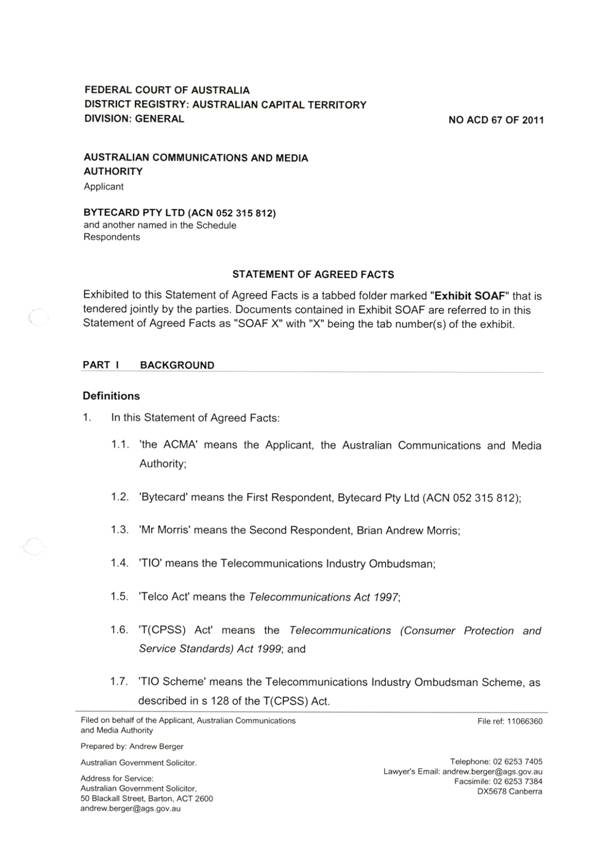
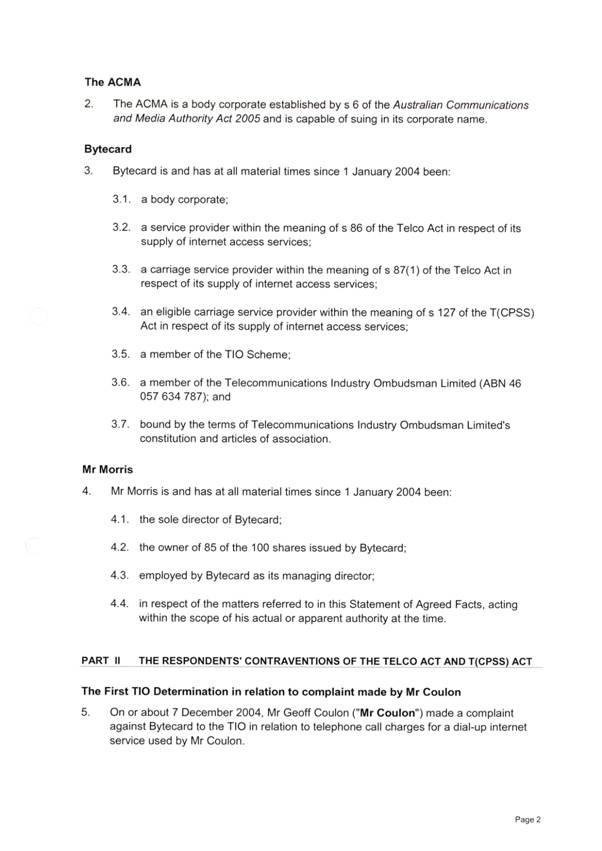
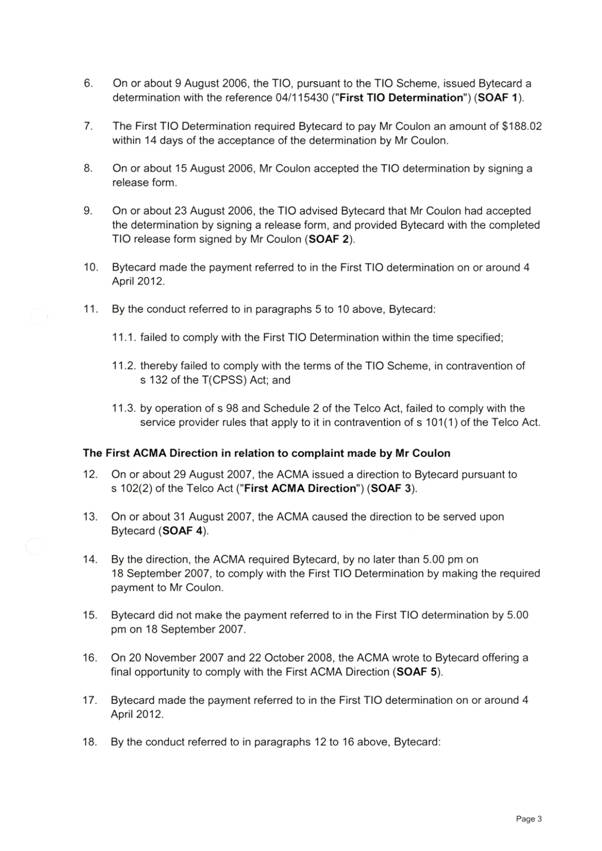
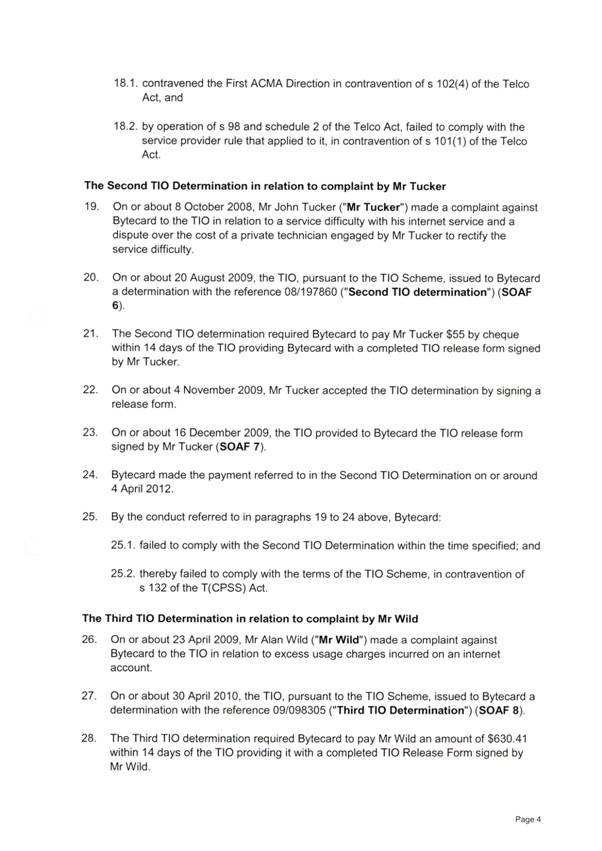
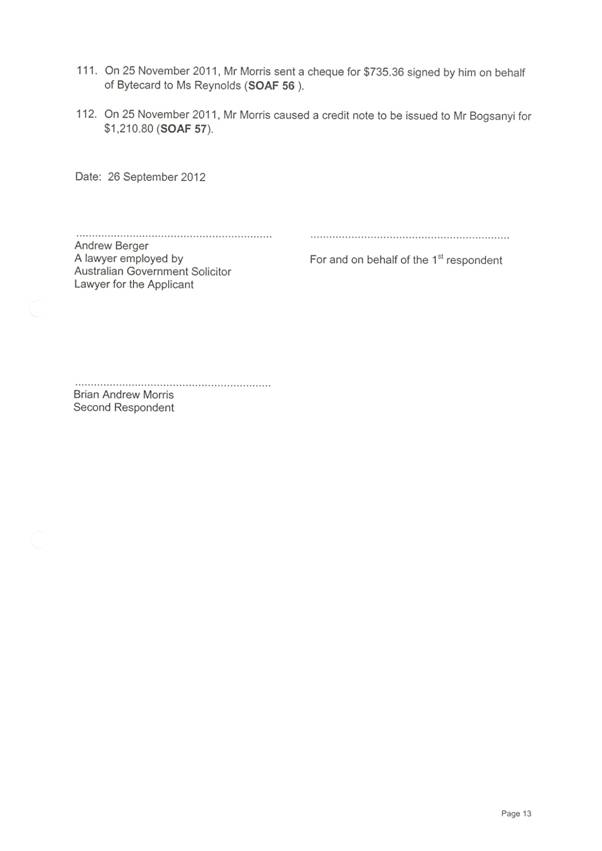
3.1 The TIO Scheme pursuant to s 132 of the Consumer Act; and
3.2 A service provider rule within the meaning of s 98 and Sch 2 of the Telco Act; and
3.3 Clause 6.1 of the TIO Constitution;
by failing to comply with a determination of the TIO dated 30 April 2010 that Bytecard pay, by a specified date, an amount of $630.41 in respect of a complaint lodged with the TIO by a customer of Bytecard, Mr Wild.
4. Bytecard has contravened s 101(1) of the Telco Act in that it failed to comply with:
4.1 The TIO Scheme pursuant to s 132 of the Consumer Act; and
4.2 A service provider rule within the meaning of s 98 and Sch 2 of the Telco Act; and
4.3 Clause 6.1 of the TIO Constitution;
by failing to comply with a determination of the TIO dated 20 August 2009 that Bytecard pay, by a specified date, an amount of $55 in respect of a complaint lodged with the TIO by a customer of Bytecard, Mr Tucker.
5. Bytecard has contravened s 101(1) of the Telco Act in that it failed to comply with:
5.1 The TIO Scheme pursuant to s 132 of the Consumer Act; and
5.2 A service provider rule within the meaning of s 98 and Sch 2 of the Telco Act; and
5.3 Clause 6.1 of the TIO Constitution;
by failing to comply with a determination of the TIO dated 14 June 2010 that Bytecard, by a specified date, waive disputed charges of $1,210.80 by applying a credit to the customer’s account, in respect of a complaint lodged with the TIO by a customer of Bytecard, Mr Bogsanyi.
6. Bytecard has contravened s 101(1) of the Telco Act in that it failed to comply with:
6.1 The TIO Scheme pursuant to s 132 of the Consumer Act; and
6.2 A service provider rule within the meaning of s 98 and Sch 2 of the Telco Act; and
6.3 Clause 6.1 of the TIO Constitution;
by failing to comply with a determination of the TIO dated 22 December 2010 that Bytecard pay a refund of $735.76, by a specified date, in respect of a complaint lodged with the TIO by a customer of Bytecard, Ms Reynolds.
7. Bytecard has contravened s 101(1) of the Telco Act, in that it failed to comply with s 102(4) of the Telco Act, by failing to comply with a written direction of ACMA issued pursuant to s 102(2) of the Telco Act dated 13 September 2011.
8. The second respondent, Brian Andrew Morris (Mr Morris), was knowingly concerned in or party to, and aided, abetted, counselled or procured, the contravening conduct of Bytecard referred to in paragraphs 1–7 above, being conduct of the kind referred to in s 101(2) of the Telco Act.
THE COURT ORDERS THAT:
9. Pursuant to s 564(1)(b) of the Telco Act, Bytecard:
9.1 If at the date of this order it is operating as an internet access service provider, within three (3) months of this order; and
9.2 Otherwise, if it recommences operation as an internet access service provider at any time between the date of this order and 1 January 2014, within three (3) months of recommencing such operation;
establish and implement a compliance program with respect to its obligations under the TIO Scheme as an internet access service provider, with particular regard to the handling of customer complaints, consistent with the obligations imposed by any applicable Industry Code in relation to customer complaints which is registered under s 117 of the Telco Act as at the date of this order:
9.3 Maintain and continue to implement the said program for a period of twelve (12) months from the date of this order; and
9.4 Use its best endeavours to ensure that the program is consistent with Australian Standard AS3806, tailored to Bytecard’s circumstances.
10. Pursuant to s 564(1)(b) of the Telco Act, Mr Morris:
10.1 Attend, at his own expense, a compliance seminar, conducted by a person on the Australasian Compliance Institute register of compliance trainers, which relates to the obligations of internet access service providers under the TIO Scheme, with particular regard to the handling of customer complaints:
10.1.1 If Mr Morris continues at the date of this order to operate Bytecard or any other business as an internet access service provider, within six (6) months of the date of this order; or
10.1.2 If Mr Morris does not operate Bytecard or any other business as an internet access service provider as at the date of this order, but at any time between the date of this order and 1 January 2014 does operate Bytecard or any other business as an internet access service provider, within 6 months of recommencing such operation; and
10.2 Notify the applicant of his attendance within seven (7) days of attending the seminar, including the date and place of the seminar and the name of the person who conducted it.
11. Pursuant to s 101(1) and s 570(1) of the Telco Act, for the contraventions described in pars 1, 2, 3, 4, 5, 6 and 7 above, the first respondent pay to the Commonwealth of Australia a pecuniary penalty of $75,000.00.
12. Pursuant to s 101(2) and s 570(1) of the Telco Act, for the contravention described in par 8 above, the second respondent pay to the Commonwealth of Australia a pecuniary penalty of $37,500.00.
13. The respondents pay the applicant’s costs of and incidental to these proceedings.
Note: Entry of orders is dealt with in Rule 39.32 of the Federal Court Rules 2011.
| AUSTRALIAN CAPITAL TERRITORY DISTRICT REGISTRY | |
| GENERAL DIVISION | ACD 67 of 2011 |
| BETWEEN: | AUSTRALIAN COMMUNICATIONS AND MEDIA AUTHORITY Applicant |
| AND: | BYTECARD PTY LTD (ACN 052 315 812) First Respondent BRIAN ANDREW MORRIS Second Respondent |
| JUDGE: | FOSTER J |
| DATE: | 1 FEBRUARY 2013 |
| PLACE: | SYDNEY (VIA VIDEO LINK TO CANBERRA) (HEARD IN CANBERRA) |
REASONS FOR JUDGMENT
1 Under the Telecommunications Act 1997 (Cth) (the Telco Act) the Australian Communications and Media Authority (ACMA), which is the applicant in this proceeding, has power to apply to this Court for an injunction restraining a person from engaging, or proposing to engage, in any conduct in contravention of the Telco Act or requiring a person to do something if that person has engaged, is engaging or is proposing to engage in conduct in contravention of the Telco Act (s 564). If a person has contravened a civil penalty provision, ACMA also has power to apply to this Court for the recovery of a pecuniary penalty against that person (s 570 and s 571).
2 In the present case, ACMA has applied to the Court for declarations to the effect that the first respondent (Bytecard) contravened s 101(1) of the Telco Act on five separate occasions by failing to comply with:
(a) The Telecommunications Industry Ombudsman (TIO) Scheme created pursuant to s 132 of the Telecommunications (Consumer Protection and Service Standards) Act 1999 (Cth) (the Consumer Act);
(b) A service provider rule within the meaning of s 98 and Sch 2 of the Telco Act; and
(c) Clause 6.1 of the TIO Constitution;
and also contravened s 101(1) of the Telco Act by failing to comply with two written directions of ACMA dated 29 August 2007 and 13 September 2011 respectively issued to it by ACMA pursuant to s 102(4) of the Telco Act.
3 ACMA also claims a declaration that the second respondent (Mr Morris) was knowingly concerned in, or party to, and aided, abetted, counselled and procured, the contraventions of the Telco Act alleged against Bytecard.
4 Section 101(1) and s 101(2) are both civil penalty provisions within the meaning of Pt 31 of the Telco Act.
5 In addition, ACMA claims mandatory injunctions pursuant to s 564(1)(b) of the Telco Act, pecuniary penalties pursuant to s 570 of the Telco Act and costs.
6 ACMA articulated its claims with precision in its Originating Application filed on 22 November 2011 and in its Statement of Claim filed on the same day.
7 Bytecard and Mr Morris filed a Defence on 19 March 2012.
8 At the time when Bytecard and Mr Morris filed their Defence, they were both represented by the same firm of solicitors. That firm ceased to act for both respondents on 26 June 2012. Thereafter, Mr Morris began acting for himself and also purported to represent Bytecard.
9 On 8 August 2012, a new firm began acting for both respondents. That firm ceased to act for those respondents on 2 October 2012.
10 The Defence filed on behalf of the respondents made significant admissions but put in issue some minor matters. By the time of the hearing, however, there was no issue of any importance left as between ACMA and Bytecard concerning the conduct engaged in by Bytecard or the question of whether that conduct constituted contraventions of the Telco Act.
11 In his Defence, Mr Morris put in issue the allegation made by ACMA at par 51.4 of its Statement of Claim. By that paragraph ACMA alleged that Mr Morris knew of the directions made by ACMA dated 29 August 2007 and 13 September 2011 respectively and caused, authorised, consented to or directed Bytecard to fail to respond to them as alleged in earlier paragraphs of the Statement of Claim. ACMA’s allegation made in par 51.4, coupled with other allegations made in pars 51.1, 51.2 and 51.3 of the Statement of Claim (all of which were admitted by Mr Morris), were the foundation of ACMA’s allegation in par 52 of the Statement of Claim to the effect that Mr Morris was directly or indirectly knowingly concerned in or party to, and aided, abetted, counselled or procured each of the contraventions by Bytecard of s 101(1) of the Telco Act relied upon by ACMA in the Statement of Claim.
12 Neither Bytecard nor Mr Morris was represented at the hearing of this proceeding. Mr Morris did not attend in person at that hearing. In those circumstances, there was no assistance provided to the Court either by or on behalf of either of the respondents. In addition, there was no attempt by or on behalf of Mr Morris to support his pleaded denial in respect of the allegations of knowing involvement in Bytecard’s contraventions.
13 I should say immediately that, having regard to the detailed facts and matters proved in evidence at the hearing by the Statement of Agreed Facts to which I will refer below, to the documents tendered by ACMA by way of support and amplification of that Statement of Agreed Facts and to the other admissions made by the respondents in their Defence as to the controlling role adopted by Mr Morris in respect of Bytecard at all relevant times, I have no hesitation in finding that the pleaded allegations as to his knowing involvement in the contraventions of the Telco Act on the part of Bytecard relied upon by ACMA in its pleadings have been made out.
14 ACMA seeks a pecuniary penalty against Bytecard in the amount of $90,000 and against Mr Morris in the amount of $45,000. In its Written Submissions filed on 5 October 2012, ACMA explained its reasoning in support of the claimed penalties in considerable detail and summarised the result of that reasoning in a table which I now reproduce as Attachment “A” to these Reasons for Judgment.
The Relevant Facts
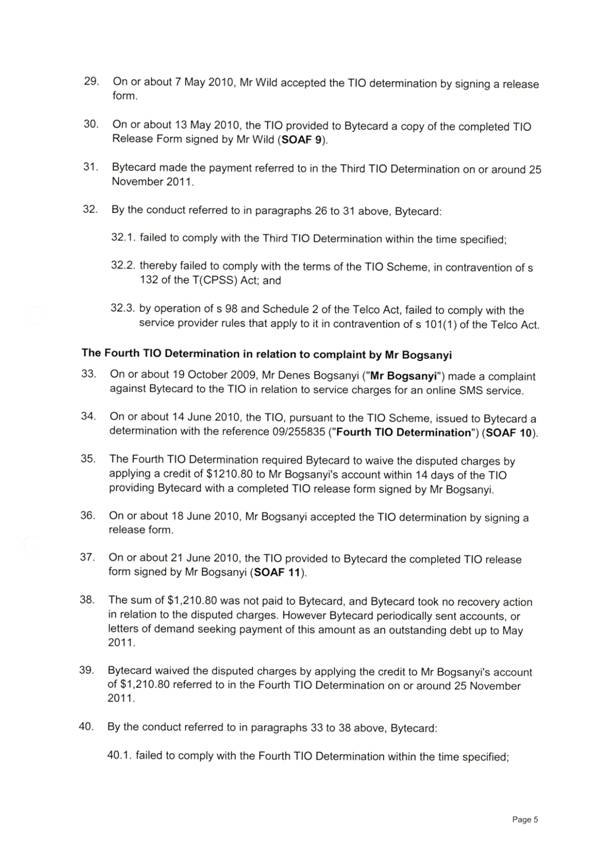
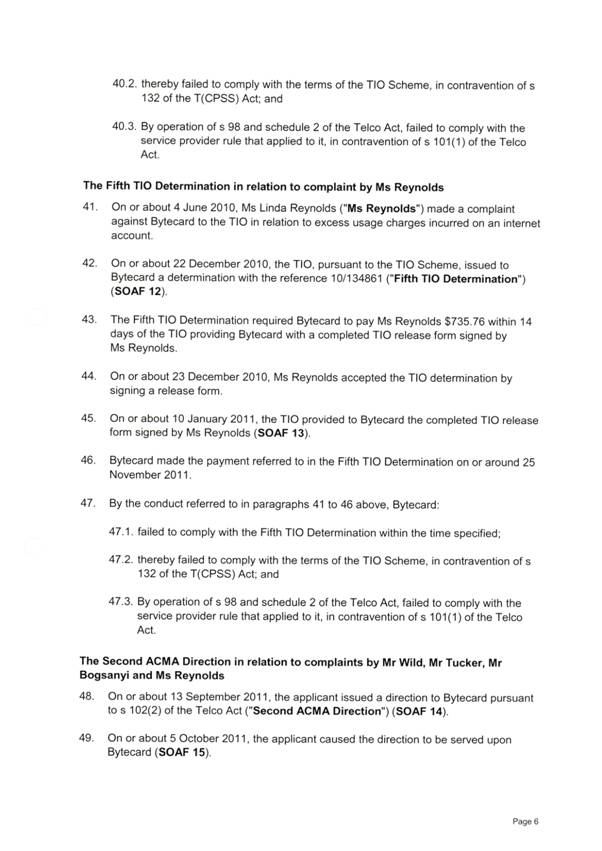
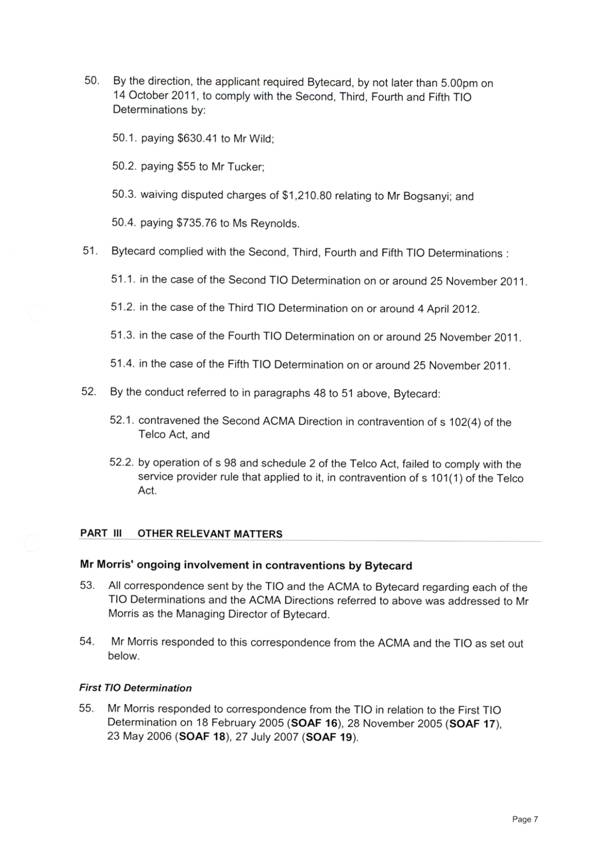
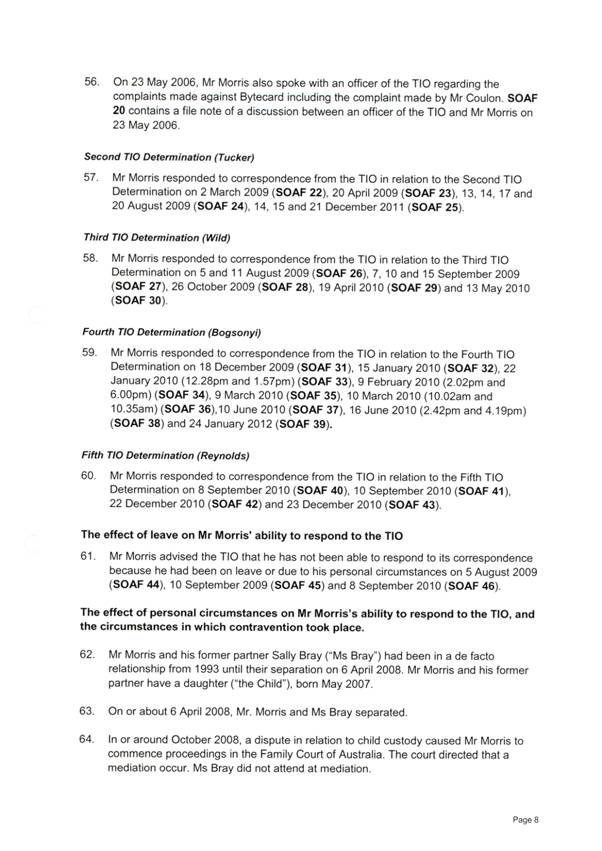
15 Attached to these Reasons for Judgment and marked Attachment “B” is the Statement of Agreed Facts which is part of Exhibit “A” and which I admitted into evidence at the hearing upon the basis that the facts set out therein had been agreed by the respondents notwithstanding that neither of them had signified their agreement to the Statement by signing it or by instructing their legal representative to sign it (Australian Communications and Media Authority v Bytecard Pty Ltd [2012] FCA 1191).
16 Within the bundle of documents (Exhibit SOAF) forming part of Exhibit “A” are many documents which record remarks made by Mr Morris, on behalf of Bytecard, to customers, to officers of the TIO and to officers of ACMA which are rude, insulting and offensive and which, in some instances, involve the use of foul language. Mr Morris’ approach to dealing with Bytecard’s customers, the TIO and ACMA is unprofessional and utterly inappropriate.
17 In addition to the unacceptable tone and content of his communications, Mr Morris has consistently displayed a complete lack of regard for the requirements of the contracts which Bytecard made from time to time with its customers and a complete lack of respect for the investigative processes legitimately undertaken by the TIO and ACMA in the proper discharge of each of those organisations’ statutory duties and responsibilities.
18 Notwithstanding the complaints made by its customers, notwithstanding the actions taken by the TIO to obtain redress for those customers’ legitimate and well-founded grievances, notwithstanding the later steps taken by ACMA, Bytecard did not make any refunds or compensation payments in any of the five cases under consideration in the present proceeding until after the present proceeding was commenced. In some cases, the payments were made some months after the filing of ACMA’s Originating Application.
19 The above matters are important factors when the Court comes to consider the appropriate penalties to impose upon Bytecard and Mr Morris for their contraventions of the Telco Act.
The TIO Scheme
20 The TIO Scheme was established in 1993. It is a free, industry funded, independent alternative dispute resolution scheme for small business and residential consumers in Australia with unresolved complaints about their telephone or internet services. The Scheme seeks to provide the independent, just, informal and speedy resolution of such complaints.
21 All telecommunications carriers and eligible carriage service providers in Australia (of which Bytecard is one) are required by statute to be members of the TIO Scheme, and by membership of the Scheme, to comply with the TIO Scheme and its Constitution including with binding decisions and determinations made after the completion of an investigation of a complaint.
22 As at the end of June 2011, there were approximately 1,200 members of the TIO Scheme. The TIO Scheme recorded over 197,000 new complaints in the 2010–2011 financial year and is the largest ADR scheme in Australia.
23 The TIO Scheme is operated by Telecommunications Industry Ombudsman Limited, (TIO Limited) which is a company limited by guarantee.
24 The TIO Scheme is governed, in part, by ss 128–133 of the Consumer Act.
25 Section 128 provides:
128 Telecommunications Industry Ombudsman scheme
(1) Each carrier and each eligible carriage service provider must, in association with other carriers and other eligible carriage service providers, enter into a scheme providing for a Telecommunications Industry Ombudsman.
Note: Section 129 provides for exemptions from subsection (1) of this section.
(2) The scheme is to be known as the Telecommunications Industry Ombudsman scheme.
(3) To avoid doubt, there is only one Telecommunications Industry Ombudsman scheme, namely, the scheme operated by Telecomunications Industry Ombudsman Limited (ABN 46 057 634 787).
(4) The scheme must provide for the Telecommunications Industry Ombudsman to:
(a) investigate; and
(b) make determinations relating to; and
(c) give directions relating to;
complaints about carriage services by end users of those services.
(4A) An end user of a carriage service is not liable to pay any fee or charge (however described) to the provider of the carriage service in respect of a complaint made by the end user about the carriage service.
(5) The following is an example of such a complaint: a complaint about billing, or the manner of charging, for the supply of carriage services.
(6) The scheme must not provide for the Telecommunications Industry Ombudsman to investigate complaints about:
(a) the levels at which tariffs charged for the supply of carriage services are set; or
(b) the content of a content service.
(7) The membership of the scheme must be open to all:
(a) carriers; and
(b) carriage service providers.
26 Members of the TIO and of the TIO Scheme agree to comply with the Articles, Memorandum and Constitution of TIO Limited and the TIO Scheme.
27 Clause 5.1(c) of the TIO Constitution requires members to provide to the TIO all documentation relevant to a complaint which has been referred to the TIO other than documentation containing confidential information of a third party who has, despite reasonable efforts of the member, refused to consent to disclosure of the information to the TIO.
28 Clause 6.1 of the TIO Constitution provides that the TIO can, after completion of an investigation and in the absence of a conciliated settlement, resolve a complaint by, amongst other things, making a determination that the member the subject of investigation pay compensation to a complainant, provide a carriage service, not impose or amend a charge or make an appropriate correction, deletion or addition to a record (cl 6.1(a)). Such a determination is automatically binding on the member.
29 The TIO can delegate the power to make binding decisions under cl 6.1 to a person occupying the position of Deputy TIO (cl 7.2).
The Relevant Provisions in the Telco Act
30 Bytecard is a telecommunications service provider within the meaning of the Telco Act. It is a service provider within the meaning of s 86 of the Telco Act in respect of its supply of internet access services, a carriage service provider within the meaning of s 87(1) in respect of the supply of internet access services and an eligible carriage service provider within the meaning of s 127 of the Consumer Act in respect of its supply of internet access services. It is also a member of the TIO Scheme and a member of TIO Limited. It is bound by the terms of TIO Limited’s Constitution and Articles of Association.
31 It is governed by service provider rules within the meaning of Pt 4, Div 5 – Service provider rules of the Telco Act.
32 Sections 101 and 102 of the Telco Act provide:
101 Service providers must comply with service provider rules
(1) A service provider must comply with the service provider rules that apply to the provider.
Note: Service provider rules is defined by section 98.
(2) A person must not:
(a) aid, abet, counsel or procure a contravention of subsection (1); or
(b) induce, whether by threats or promises or otherwise, a contravention of subsection (1); or
(c) be in any way, directly or indirectly, knowingly concerned in, or party to, a contravention of subsection (1); or
(d) conspire with others to effect a contravention of subsection (1).
(3) Subsections (1) and (2) are civil penalty provisions.
Note: Part 31 provides for pecuniary penalties for breaches of civil penalty provisions.
102 Remedial directions—breach of service provider rules
(1) This section applies if a service provider has contravened, or is contravening, a service provider rule.
(2) The ACMA may give the provider a written direction requiring the provider to take specified action directed towards ensuring that the provider does not contravene the rule, or is unlikely to contravene the rule, in the future.
(3) The following are examples of the kinds of direction that may be given to a service provider under subsection (2):
(a) a direction that the provider implement effective administrative systems for monitoring compliance with a service provider rule;
(b) a direction that the provider implement a system designed to give the provider’s employees, agents and contractors a reasonable knowledge and understanding of the requirements of a service provider rule, in so far as those requirements affect the employees, agents or contractors concerned.
(4) A service provider must not contravene a direction under subsection (2).
(5) Subsection (1) does not apply to the rule set out in Part 1 of Schedule 2 in so far as that rule relates to section 369.
Note: Section 369 deals with Rules of Conduct under section 367.
(6) Subsection (1) does not apply to the rule set out in subsection 152BA(2) of the Competition and Consumer Act 2010.
Note: Subsection 152BA(2) of the Competition and Consumer Act 2010 provides that a carriage service provider must comply with any standard access obligations that are applicable to the provider.
(6A) Subsection (1) does not apply to the rule set out in subsection 152BCP(2) of the Competition and Consumer Act 2010.
Note: Subsection 152BCP(2) of the Competition and Consumer Act 2010 provides that a carriage service provider must comply with any access determinations that are applicable to the provider.
(6B) Subsection (1) does not apply to the rule set out in subsection 152BDG(2) of the Competition and Consumer Act 2010.
Note: Subsection 152BDG(2) of the Competition and Consumer Act 2010 provides that a carriage service provider must comply with any binding rules of conduct that are applicable to the provider.
(6C) Subsection (1) does not apply to the rule set out in subsection 152BED(2) of the Competition and Consumer Act 2010.
Note: Subsection 152BED(2) of the Competition and Consumer Act 2010 deals with access agreements.
(6D) Subsection (1) does not apply to the rule set out in subsection 152CJD(2) of the Competition and Consumer Act 2010.
Note: Subsection 152CJD(2) of the Competition and Consumer Act 2010 deals with rules about the supply of services by NBN corporations.
(6E) Subsection (1) does not apply to the rule set out in subsection 38(2) of the National Broadband Network Companies Act 2011.
Note: Subsection 38(2) of the National Broadband Network Companies Act 2011 deals with rules about:
(a) the supply of goods and services by NBN corporations; and
(b) the investment of money by NBN corporations; and
(c) the functional separation of NBN corporations; and
(d) the divestment of assets by NBN corporations.
(7) A direction under subsection (2) is not a legislative instrument for the purposes of the Legislative Instruments Act 2003.
33 Section 564 of the Telco Act gives power to ACMA to apply to this Court for injunctive relief.
34 Section 571(1) of the Telco Act gives to ACMA the power to institute a proceeding in this Court for the recovery on behalf of the Commonwealth of a pecuniary penalty referred to in s 570.
35 Section 570 is in the following terms:
570 Pecuniary penalties for contravention of civil penalty provisions
(1) If the Federal Court is satisfied that a person has contravened a civil penalty provision, the Court may order the person to pay to the Commonwealth such pecuniary penalty, in respect of each contravention, as the Court determines to be appropriate.
(2) In determining the pecuniary penalty, the Court must have regard to all relevant matters, including:
(a) the nature and extent of the contravention; and
(b) the nature and extent of any loss or damage suffered as a result of the contravention; and
(c) the circumstances in which the contravention took place; and
(d) whether the person has previously been found by the Court in proceedings under this Act to have engaged in any similar conduct.
(3) The pecuniary penalty payable under subsection (1) by a body corporate is not to exceed:
(a) in the case of a contravention of subsection 68(1) or (2) or 101(1) or (2)—$10 million for each contravention; or
(b) in any other case—$250,000 for each contravention.
(4) The pecuniary penalty payable under subsection (1) by a person other than a body corporate is not to exceed $50,000 for each contravention.
(4A) Subsections (3) and (4) do not apply to a contravention of subsection 139(1) or (2).
(4B) Section 25 of the Do Not Call Register Act 2006 applies to a contravention of subsection 139(1) or (2) of this Act in a corresponding way to the way in which it applies to a contravention of subsection 12(1) or (2) of the Do Not Call Register Act 2006, subject to the following modifications:
(a) each reference in section 25 of the Do Not Call Register Act 2006 to subsection 24(1) of that Act includes a reference to subsection (1) of this section;
(b) each reference in section 25 of the Do Not Call Register Act 2006 to a civil penalty provision includes a reference to subsection 139(1) or (2) of this Act;
(c) each reference in section 25 of the Do Not Call Register Act 2006 to a civil penalty order includes a reference to an order under subsection (1) of this section.
(5) If conduct constitutes a contravention of 2 or more civil penalty provisions, proceedings may be instituted under this Act against a person in relation to the contravention of any one or more of those provisions. However, the person is not liable to more than one pecuniary penalty under this section in respect of the same conduct. This subsection has effect subject to subsection (6).
(6) If conduct constitutes a contravention of:
(a) section 68 or 101; and
(b) one or more other civil penalty provisions;
proceedings must not be instituted under this Act against the person in relation to the contravention of section 68 or 101, as the case may be.
(7) In this section:
this Act includes:
(a) the Telecommunications (Consumer Protection and Service Standards) Act 1999 and regulations under that Act; and
(b) Part 6 of the Telecommunications Universal Service Management Agency Act 2012.
36 In addition to the above legislative provisions, the Court has ample power to make declarations of the kind claimed by ACMA in the present proceeding.
Consideration
The Relevant Principles
37 The maximum civil penalty for a contravention of s 101(1) or s 101(2) of the Telco Act is:
(a) $10 million for each contravention by a body corporate; and
(b) $50,000 for each contravention by an individual.
38 At 372 [31] in Markarian v The Queen (2005) 228 CLR 357, Gleeson CJ, Gummow, Hayne and Callinan JJ said:
It follows that careful attention to maximum penalties will almost always be required, first because the legislature has legislated for them; secondly, because they invite comparison between the worst possible case and the case before the court at the time; and thirdly, because in that regard they do provide, taken and balanced with all of the other relevant factors, a yardstick. That having been said, in our opinion, it will rarely be, and was not appropriate for Hulme J here to look first to a maximum penalty (The maximum selected by his Honour was not, as will appear, the maximum available in respect of the principal offence.), and to proceed by making a proportional deduction from it. That was to use a prescribed maximum erroneously, as neither a yardstick, nor as a basis for comparison of this case with the worst possible case. That he used the maximum penalty impermissibly appears from his Honour's particular deference to it in this passage ((2003) 137 A Crim R 497 at 506 [37]):
“Parliament cannot have intended that, other things being equal, the penalty for supplying more than 250 g should be less than for supplying that quantity.”
The form of the statement is explained by the fact that his Honour did not start with the maximum penalty for an offence involving the quantity in question, but used another maximum penalty as his starting point, that is, the maximum for an offence in the category of seriousness immediately below that of the principal offence.
39 In this Court, these remarks by the High Court in Markarian have been held to apply to the imposition of civil penalties (see Australian Ophthalmic Supplies Pty Ltd v McAlary-Smith (2008) 165 FCR 560 at 584 [108]; and Secretary, Department of Health and Ageing v Export Corp (Aust) Pty Ltd (2012) 288 ALR 702 at 714 [49]–[50] and at 718 [67]).
40 It is obvious that the legislature has given the clearest possible indication that contraventions of s 101(1) or (2) are to be considered as serious matters when the Court comes to the question of imposing a civil penalty.
41 The principal object of civil penalty provisions is to ensure deterrence. In Trade Practices Commission v CSR Limited [1991] ATPR 41-076, which was a case dealing with s 76 of the Trade Practices Act 1974 (Cth), French J said (at p 52,152):
The principal, and I think the only, object of the penalties imposed by s 76 is to attempt to put a price on contravention that is sufficiently high to deter repetition by the contravenor and by others who might be tempted to contravene the Act.
42 The dictum of French J in Trade Practices Commission v CSR Limited which I have extracted at [41] above has been applied not only in the trade practices context but in a wide variety of other regulatory regimes. In particular, the need for a penalty to have a proper deterrent effect has been emphasised in the context of laws passed by the Parliament to protect the environment.
43 Counsel for ACMA submitted that I should approach the determination of the penalties to be imposed in the present case by applying the process commonly called “instinctive synthesis”. That process, as I understand it, has the following attributes:
(a) There must be a weighing of all relevant factors, rather than starting from a predetermined figure and making incremental additions or subtractions for each separate factor (Markarian at 373–375 [36]–[39] per Gleeson CJ, Gummow, Hayne and Callinan JJ and at 385–387 [69]–[73] per McHugh J); and
(b) It is critical that the reasoning process involved in synthesising the penalty be transparent (Markarian at 373–375 [36]–[39] per the plurality and at 390 [84] per McHugh J).
The Relevant Factors
44 I am required to consider the factors specified in s 570(2) of the Telco Act.
45 Counsel for ACMA submitted that other relevant factors in civil penalty cases ordinarily include:
(a) The deliberateness of the contravention and the period over which it extended;
(b) Whether the contravention arose out of the conduct of senior management or at a lower level;
(c) Whether the corporation has a corporate culture conducive to compliance with the relevant legislative provisions;
(d) Whether the corporation has shown a disposition to co-operate with the authorities responsible for the enforcement of the relevant legislative provisions in relation to the contravention; and
(e) The financial position of the contravenor and capacity to pay.
The Relevant Factors in the Present Case
The Nature and Extent of the Contraventions (s 570(2)(a))
46 The contraventions in the present case should be regarded as very serious. The provision of telecommunication services is a very important feature of modern society. There are many organisations involved in the provision of those services at various levels. The need for those organisations which deal directly with the public to behave in a manner which complies with relevant statutory provisions, the terms of their contracts and appropriate professional standards is obvious. In the present case:
(a) The contraventions were not an isolated or a “one off” activity. The contraventions occurred over a very prolonged period (almost six years between August 2006 and April 2010);
(b) There was a total of seven contraventions in five separate matters;
(c) Bytecard and Mr Morris failed to co-operate with the TIO and ACMA. They failed to remedy the contraventions, notwithstanding repeated requests to do so. They were given many warnings of what might follow should they not remedy the contraventions and nonetheless ignored those warnings.
The Nature and Extent of any Loss or Damage (s 570(2)(b))
47 The individual amounts involved in the contraventions are small. However, in some cases, as far as the particular customer was concerned, the amounts might well have been significant.
The Circumstances of the Contraventions (s 570(2)(c))
48 Counsel for ACMA submitted that the circumstances in which the contraventions occurred constituted the most serious feature of the contraventions. He submitted that, not only did they take place in the face of repeated and ongoing requests and warnings, but they involved subjecting both customers and officers of statutory bodies performing statutory functions to the most appalling treatment and insults.
49 Counsel for ACMA submitted that the repeatedly abusive approach adopted by Mr Morris demonstrated that the respondents’ contravening behaviour was persistent, deliberate, wilful and contumelious. Counsel submitted that these circumstances are highly aggravating circumstances and ought to be regarded by the Court as placing the contravening conduct well beyond the lowest end of the range of penalties. Counsel also submitted that the personal difficulties confronted by Mr Morris at various times in the relevant period could not sensibly be regarded as an explanation or justification for the approach which he and Bytecard took to the various matters raised with them.
50 When appropriate consideration is given to the contents of the Statement of Agreed Facts and to the documents comprising Exhibit SOAF, I have to say that I agree with the submissions made by Counsel on behalf of ACMA which I have summarised at [48]–[49] above.
Previous Similar Conduct (s 570(2)(d))
51 Neither Bytecard nor Mr Morris have been found to have engaged in any similar conduct. This must be a factor in favour of both of them.
Deterrence
52 The authorities recognise that deterrence has two aspects:
(a) Specific deterrence in respect of the actual contravenor or contravenors; and
(b) General deterrence of others who may be disposed to engage in prohibited conduct of a similar kind.
Specific Deterrence
53 At [28]–[29] of its submissions, ACMA submitted the following:
28. As noted above, the respondents persisted in their contravening conduct notwithstanding advice, warnings and the service of remedial directions. It was not until after these proceedings were commenced that they remedied their noncompliance. This flagrant and persistent resistance to proper regulatory compliance and the complete absence of any evidence or material which suggests any real contrition or remorse or apprehension of the inappropriateness of their actions underscores the need for a penalty which involves a strong element of specific deterrence (See for example Australian Securities and Investments Commission v Soust (No 2) (2010) 76 ACSR 1 at [60]) and [66]).
29. The respondents’ lack of contrition or remorse or apprehension of the inappropriateness of their actions is also suggested by the following:
29.1. On 1 June 2012 the respondents were ordered to file and serve any evidence upon which they proposed to rely at the final hearing by 5pm on 27 July 2012. This order had not been complied with as at 10 August 2012 when the matter was relisted.
29.2. On 10 August 2012 the respondents were ordered to file and serve a Statement of Agreed Facts, Issues and Contentions and any evidence upon which they intend to rely at the final hearing by 5pm on 7 September 2012. This order had not been complied with as at 26 September 2012 when the matter was relisted.
29.3. The respondents contended that the e-mails they had sent to the TIO referred to in the affidavit of Doron Michael Karliner affirmed on 28 September 2012 were not relevant to these proceedings (See exhibit A from the directions hearing before Nicholas J on 26 September 2012) – thereby requiring the applicant to seek to prove the contents of these emails by serving notices to admit facts, and affidavit evidence.
54 I agree with that submission.
55 There is a very strong case for imposing penalties on the respondents in the present proceeding which mark the Court’s intention to ensure that the respondents do not continue in their dealings with the public and the authorities with the disrespect of both that has been manifested by their conduct which is the subject of complaint in the present case.
General Deterrence
56 The penalties which the Court is obliged to impose must be such as to send a strong message to other potential contravenors that contraventions will not pay. Penalties must not be so high as to be oppressive.
57 At pars 33–35 of ACMA’s Written Submissions, it submitted the following:
33. The telephone and internet are, notoriously, a vital aspect of a significant number of small businesses’ and households’ employment, commercial, educational, domestic and/or recreational activities. The provisions of Division 5 of Part 4 of the Telco Act, and the TIO scheme established under it, are designed to provide a free, independent alternative dispute resolution scheme for small business and residential consumers in Australia with unresolved complaints about their telephone or internet services. The scheme seeks to provide for the independent, just, informal and speedy resolution of such complaints. This advances the objects of the Act set out in s 3, including the main objects of providing:
... a regulatory framework that promotes:
(a) the long-term interests of end-users of carriage services or of services provided by means of carriage services; and
(b) the efficiency and international competitiveness of the Australian telecommunications industry; and
(c) the availability of accessible and affordable carriage services that enhance the welfare of Australians.
34. Abiding by the ‘umpire's decision’ is self evidently an important part of the TIO Scheme. If members of the TIO Scheme fail to comply with determinations of the TIO the effectiveness of the Scheme is likely to quickly and significantly diminish and thereby potentially have consequences such as the following:
34.1. discouraging Australian small businesses and households who experience difficulties with their telephone and/or internet services from seeking redress;
34.2. reducing public confidence in Australia's telephone and/or internet service industry;
34.3. discouraging the use of telephone and/or internet services;
34.4. increasing the resources required by the TIO and the ACMA to try and ensure compliance with the Telco Act, and
34.5. undermining the objects of the Telco Act.
35. In this case, the ongoing, intentional, contumelious and otherwise aggravating features of the contravening conduct underscore the need to ensure that other would be contravenors are in no doubt that such conduct will attract strong penalties.
58 Once again, I find myself in complete agreement with the submissions made on behalf of ACMA.
59 It is important in the present case to recognise that, taken individually, each of the primary contraventions (the failure to deal adequately with the legitimate complaints of customers) produced relatively minor financial detriment to each of those customers. Had Bytecard and Mr Morris attempted to address those customers’ legitimate complaints promptly and in a genuine if misguided fashion, the relatively minor nature of the financial detriment would weigh heavily in favour of penalties at the lower end of the spectrum. However, instead of approaching those complaints in an appropriate fashion, Bytecard and Mr Morris set upon a course of action which can only be described as a deliberate and flagrant non-compliance with Bytecard’s business and statutory obligations, overlain, as it obviously was, with disrespectful and abusive language.
60 In my judgment, I have to give significant weight to general deterrence in fixing the penalties in the present case in order to ensure that others who might be inclined to think that they can behave as Bytecard and Mr Morris have in the present case, will be discouraged from doing so.
Co-operation
61 Co-operation with the relevant authorities during the investigation phase and subsequently in relation to any proceedings which are brought will usually be a mitigating factor that should be considered by the Court as potentially reducing the penalty that would otherwise have been imposed. The size of any discount will vary according to the circumstances of the particular case. There may be no discount, or only a small one, where relevant admissions come late in the proceedings and amount to little more than an acceptance of the inevitable (Mornington Inn Pty Ltd v Jordan (2008) 168 FCR 383 at 405 [76]–[78]).
62 Counsel for ACMA accepted that the respondents ought to be given credit for their co-operation in the present proceedings reflected through (in the case of Bytecard) filing a Defence admitting the contraventions and (in the case of both respondents) assisting in the preparation of the Statement of Agreed Facts.
63 However, it must be remembered that Mr Morris did not withdraw his denial of individual responsibility made in his Defence. True it was that the Statement of Agreed Facts put the lie to that denial but nonetheless the denial remained in place. Furthermore, in my judgment, this is a case where the contraventions would have inevitably been proven to the satisfaction of the Court. Also, both respondents withheld their signature from the Statement of Agreed Facts.
64 Counsel for ACMA submitted that the respondents should be given a discount for co-operation in the order of no more than 10%.
The Relevance of Other Decisions
65 Counsel for ACMA drew my attention to two other decisions in which this Court has dealt with contraventions of the Telco Act constituted by failure to comply with TIO determinations and/or ACMA directions and submitted that they were of limited assistance in the present case. He also submitted that it would be wrong in principle to examine penalties in those cases and compare the circumstances of those cases with the present case in order to fix penalties in the present case.
66 I have not found the cases to which my attention was drawn helpful in arriving at the appropriate penalty in the present case.
Conclusions on Penalty
67 There were aggravating circumstances in relation to all of the contraventions in the present case. This was particularly so in relation to the Bogsanyi matter. Those circumstances justify giving considerable weight to the need for specific and general deterrence.
68 On the other side of the ledger, allowance should be made for the lack of prior history and for the co-operation ultimately undertaken by both Bytecard and Mr Morris with ACMA.
69 Each of the contraventions was separate and distinct and did not, in my judgment, comprise a course of conduct. For this reason, a penalty for each contravention is appropriate. ACMA accepted that, if that approach is taken, the Court should also have regard to the so called “totality” principle and conduct a final check to ensure that the final penalty or aggregate penalty is not unjust or out of proportion to the circumstances of the case (Mornington Inn Pty Ltd v Jordan (at 386–388 [4]–[11] per Gyles J and at 396–401 [41]–[58] per Stone and Buchanan JJ). I shall have regard to that principle in this case.
70 Counsel for ACMA submitted that, once the Court weighed all the relevant factors, the appropriate penalties were $90,000 for Bytecard and $45,000 for Mr Morris arrived at in accordance with the breakdown set out in Attachment “A” to these Reasons for Judgment.
71 Weighing all of the factors to which I have referred at [44]–[64] above and taking due account of the principles to which I have referred at [37]–[43] and [61] and [62] above, I am satisfied that I should approach the matter broadly along the lines advocated by ACMA. In my judgment, however, the penalties sought against the respondents for the first three contraventions are too severe. I would adjust the penalties for the first TIO determination (Mr Coulon), the first ACMA direction (Mr Coulon) and the second TIO determination (Mr Tucker) by reducing each of those penalties in the case of Bytecard to $5,000, $10,000 and $12,000 respectively and making a similar adjustment in respect of Mr Morris. This reduces the total for Bytecard before discounts to $134,000 and the total in respect of Mr Morris to $67,000. I would then reduce the totals for each of the respondents to $85,000 and $42,500 by way of discount in order to take account of the totality principle. I then propose to allow a further discount for co-operation in each case reducing the penalties further to $75,000 in the case of Bytecard and $37,500 in the case of Mr Morris.
Declarations and Injunctions
72 In the circumstances of the present case, I consider it to be important that the Court make the declarations claimed by ACMA and I propose to do so. I will also grant the injunction by which ACMA sought the imposition of a compliance program on Bytecard and on Mr Morris. There is no need to grant the additional injunction sought by ACMA in relation to the payment of compensation since Bytecard has attended to dealing with that matter prior to the hearing.
73 There will be orders accordingly.
| I certify that the preceding seventy-three (73) numbered paragraphs are a true copy of the Reasons for Judgment herein of the Honourable Justice Foster. |
Associate:
Attachment “A”
| Bytecard | Mr Morris | |
| The First TIO determination (Mr Coulon) | 10,000 | 5,000 |
| The First ACMA Direction (Coulon) | 15,000 | 7,500 |
| The Second TIO determination (Mr Tucker) | 16,000 | 8,000 |
| The Third TIO determination (Mr Wild) | 11,000 | 5,500 |
| The Fourth TIO determination (Mr Bogsanyi) | 50,000 | 25,000 |
| The Fifth TIO determination (Ms Reynolds) | 16,000 | 8,000 |
| The Second ACMA Direction (Tucker, Wild, Bogsanyi and Reynolds) | 30,000 | 15,000 |
| Total | 148,000 | 74,000 |
| Discounted to take account of the totality principle | 100,000 | 50,000 |
| Discounted further due to co-operation | 90,000 | 45,000 |
Attachment “B”