

FEDERAL COURT OF AUSTRALIA
Mundraby on behalf of the Combined Mandingalbay Yidinji-Gunggandji People v State of Queensland [2012] FCA 1039
|
IN THE FEDERAL COURT OF AUSTRALIA |
|
|
DATE OF ORDER: |
|
|
WHERE MADE: |
THE COURT ORDERS THAT:
Being satisfied that a determination in the terms sought by the parties is within the power of the Court, and it appearing appropriate to the Court to do so,
BY CONSENT THE COURT DETERMINES THAT:
1. Native title exists in relation to the Determination Area identified in Schedule 2.
2. The native title is held by the persons described in Schedule 1 (the “native title holders”).
3. Subject to paragraphs 5, 6 and 7 the nature and extent of the native title rights and interests, other than in relation to Water, are the rights to possession, occupation, use and enjoyment to the exclusion of all others.
4. Subject to paragraphs 5, 6 and 7 the nature and extent of the native title rights and interests in relation to Water within the Determination Area are the non-exclusive rights to:
(a) hunt, fish and gather from the Water of the area;
(b) take and use the Natural Resources of the Water of the area; and
(c) take and use the Water of the area,
for personal, domestic and non-commercial communal purposes.
5. There are no native title rights and interests in or in relation to minerals as defined by the Mineral Resources Act 1989 (Qld) and petroleum as defined by the Petroleum Act 1923 (Qld) and the Petroleum and Gas (Production and Safety) Act 2004 (Qld).
6. The native title rights and interests are subject to and exercisable in accordance with:
(a) the Laws of the State and the Commonwealth; and
(b) the traditional laws acknowledged and traditional customs observed by the native title holders.
7. The native title rights and interests referred to in paragraph 4 do not confer possession, occupation, use or enjoyment to the exclusion of all others.
8. The nature and extent of any other rights and interests in relation to the Determination Area (or respective parts thereof) are set out in Schedule 3.
9. The relationship between the native title rights and interests described in paragraphs 3 and 4, and the other rights and interests described in Schedule 3, other than paragraph 1(g) of Schedule 3,(the “other rights and interests”) is that:
(a) the other rights and interests continue to have effect, and the rights conferred by or held under the other rights and interests may be exercised notwithstanding the existence of the native title rights and interests;
(b) to the extent the other rights and interests are inconsistent with the continued existence, enjoyment or exercise of the native title rights and interests in relation to the land and waters of the Determination Area identified in Schedule 2, the native title continues to exist in its entirety but the native title rights and interests have no effect in relation to the other rights and interests to the extent of the inconsistency for so long as the other rights and interests exist; and
(c) the other rights and interests and any activity that is required or permitted by or under, and done in accordance with, the other rights and interests, or any activity that is associated with or incidental to such an activity, prevail over the native title rights and interests and any exercise of the native title rights and interests.
10. The relationship between the native title rights and interests described in paragraphs 3 and 4 above and the interests described in paragraph 1(g) of Schedule 3 is that the interests co-exist.
11. The words and expressions used in this determination have the same meanings as they have in Part 15 of the Native Title Act 1993 (Cth) except for the following defined words and expressions:
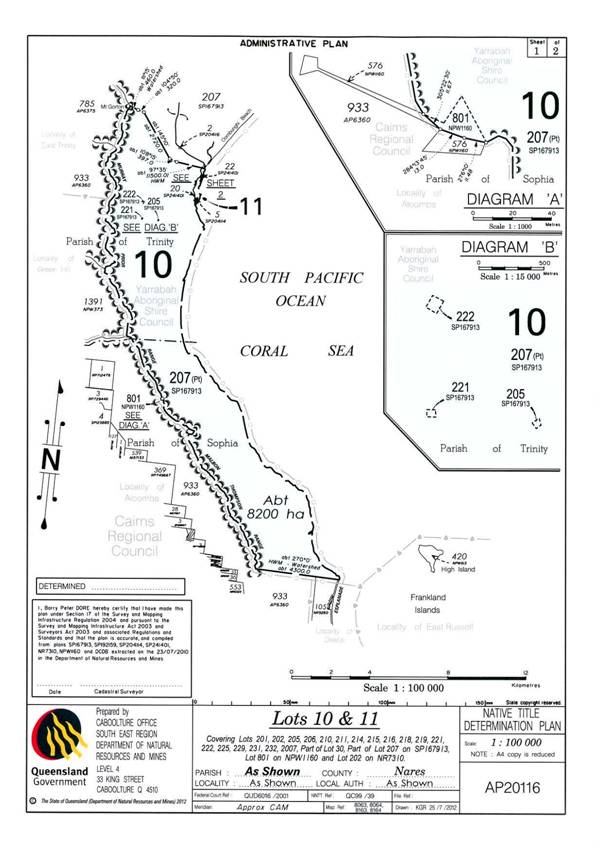
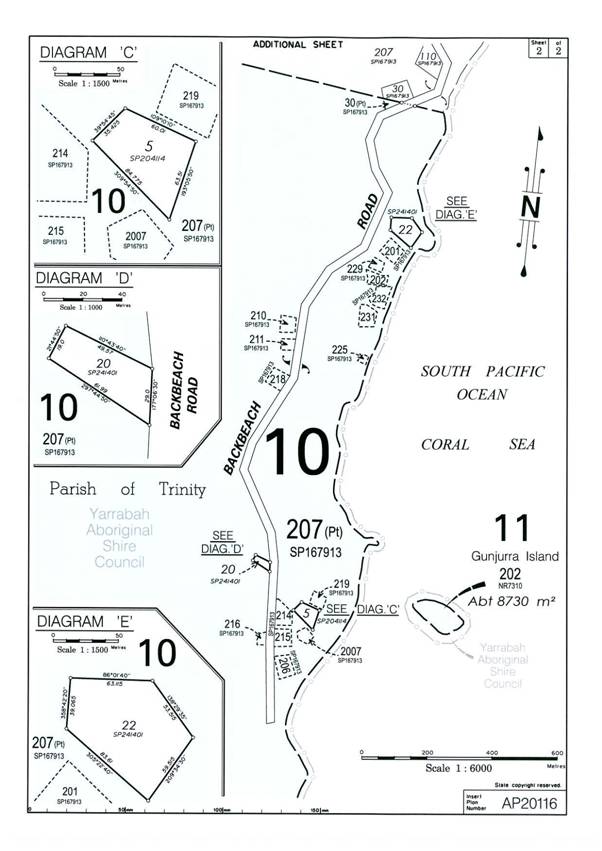
“Determination Area” means the land and waters described in Part A of Schedule 2 and shown on the plan in Part B of Schedule 2, and to the extent of any inconsistency between them, Part A of Schedule 2 prevails;
“High Water Mark” has the meaning given in the Land Act 1994 (Qld);
“Laws of the State and the Commonwealth” means the common law and the laws of the State of Queensland and the Commonwealth of Australia, and includes legislation, regulations, statutory instruments, local planning instruments and local laws;
“Water” means water as defined by the Water Act 2000 (Qld).
THE COURT DETERMINES THAT:
12. The native title is not to be held in trust.
13. An Aboriginal Corporation whose name will be nominated in writing within six months is to:
(a) be the prescribed body corporate for the purposes of s 57(2) of the Native Title Act 1993 (Cth); and
(b) perform the functions mentioned in s 57(3) of the Native Title Act 1993 (Cth).
14. In the event that there is no nomination within the time specified in paragraph 13 or such later time as the Court may order, the Registered Native Title Claimants are to forthwith apply to the Court for further directions.
15. Until such time as there is a prescribed body corporate in relation to the Determination Area any notices required under the Native Title Act 1993 (Cth) or otherwise to be served on the Native Title Holders, the native title claim group or the Registered Native Title Claimants may be served upon the North Queensland Land Council Native Title Representative Body Aboriginal Corporation, and such notice shall be deemed to be sufficient.
SCHEDULE 1 – Native title holders
The native title holders are those Aboriginal People:
who are Mandingalbay Yidinji-Gunggandji People on the basis of descent from one of the following persons:
(a) (i) Merumanai II, or his wife Tonkobulu of King Beach (being the parents of Albert Underwood, Djaradjoan, Menmuny/King John Barlow/Merumanai III, and Nellie married to Loui);
(ii) Billy Brown (husband of Jinny Katchewan of Cape Grafton);
(iii) Billy Church/Goondor (the father of Maggie 1, Maggie 2 and Nora);
(iv) Kari (the father of George Christian);
(v) Mandi Tjapir (sister of Kari and wife of Billy Church);
(vi) Kutubi/Bertie Harris;
(vii) Mary Ann, or her brother Paddy of Jilji (husband of Nora);
(viii) Nego/Nengo (the mother of Maggie 2);
(ix) Mandekala of Cape Grafton or Njemnga/Njewnga of Cape Grafton (the parents of Jinny Katchewan of Cape Grafton);
(x) Rosie of Buddabadoo;
(xi) Billy (Woopah) of Buddabadoo;
(xii) Harry Myngha;
(xiii) Jabalum Mandingalpai (aka Jimmy); or
(b) who have been recruited by adoption as a member of the Mandingalbay Yidinji-Gunggandji People in accordance with their traditional law and custom.
SCHEDULE 2 – Determination Area
PART A
All of the land and waters described in column 1 of the following table and shown on the determination plan described in column 2 of the following table, excluding any area of land and waters on which a public work, as defined in s 253 of the Native Title Act 1993 (Cth) (“the Act”), is constructed, established or situated, and to which ss 23B(7) and 23C(2) of the Act and/or s 23B(7) of the Native Title Act 1993 (Cth) and s 21 of the Native Title (Queensland) Act 1993, applies, together with any adjacent land and waters in accordance with s 251D of the Act:
Areas where exclusive native title exists
|
Area Description |
Lot on Determination Plan |
|
Part of Lot 207 on Plan SP167913, being within that part of the Yarrabah deed of grant in trust (‘DOGIT’), commencing at the southernmost south eastern corner of Lot 207 on Plan SP167913, being a point on the high water mark, and extending westerly along the boundary of that lot to the southernmost south western corner; then generally north westerly and generally northerly along boundaries of that lot to the eastern most corner of Lot 785 on Plan AP6375; then generally south easterly to a point having longitude 145.867794° East, latitude 16.951805° South, thence to a point having longitude 145.870594° East, latitude 16.952830° South, thence to a point having longitude 145.882940° East, latitude 16.974384° South, thence to a point having longitude 145.886341° East, latitude 16.975861° South, then south easterly to the western boundary of an unnamed road at latitude 16.978930° South; then generally southerly, north easterly and generally northerly along the boundaries of that road to latitude 16.978980° South; then easterly to the high water mark at latitude 16.979267° South; then generally southerly along the high water mark back to the commencement point. High Water Mark is as defined in the Land Act 1994 (Qld), excluding Lot 5 on SP204114, Lot 20 on SP241401 and Lot 22 on SP241401. All datam referred to above is GDA94. |
Lot 10 on Plan AP20116 |
|
Lot 30 (Pt) on Plan SP167913 |
Lot 10 on Plan AP20116 |
|
Lot 201 on Plan SP167913 |
Lot 10 on Plan AP20116 |
|
Lot 202 on Plan SP167913 |
Lot 10 on Plan AP20116 |
|
Lot 205 on Plan SP167913 |
Lot 10 on Plan AP20116 |
|
Lot 206 on Plan SP167913 |
Lot 10 on Plan AP20116 |
|
Lot 210 on Plan SP167913 |
Lot 10 on Plan AP20116 |
|
Lot 211 on Plan SP167913 |
Lot 10 on Plan AP20116 |
|
Lot 214 on Plan SP167913 |
Lot 10 on Plan AP20116 |
|
Lot 215 on Plan SP167913 |
Lot 10 on Plan AP20116 |
|
Lot 216 on Plan SP167913 |
Lot 10 on Plan AP20116 |
|
Lot 218 on Plan SP167913 |
Lot 10 on Plan AP20116 |
|
Lot 219 on Plan SP167913 |
Lot 10 on Plan AP20116 |
|
Lot 222 on Plan SP167913 |
Lot 10 on Plan AP20116 |
|
Lot 221 on Plan SP167913 |
Lot 10 on Plan AP20116 |
|
Lot 225 on Plan SP167913 |
Lot 10 on Plan AP20116 |
|
Lot 229 on Plan SP167913 |
Lot 10 on Plan AP20116 |
|
Lot 231 on Plan SP167913 |
Lot 10 on Plan AP20116 |
|
Lot 232 on Plan SP167913 |
Lot 10 on Plan AP20116 |
|
Lot 2007 on Plan SP167913 |
Lot 10 on Plan AP20116 |
|
Lot 202 on Plan NR7310 to the High Water Mark. |
Lot 11 on Plan AP20116 |
|
Lot 801 on Plan NPW1160 |
Lot 10 on Plan AP20116 |
PART B – Determination plans
SCHEDULE 3 – Other interests in the determination area
1. The rights and interests of the parties under the following indigenous land use agreements:
(a) Les Murgha, Charles Garling, Vincent Mundraby, State of Queensland and Yarrabah Aboriginal Shire Council as parties to the Yarrabah Blockholders ILUA QI2011/54, registered on 28 June 2012;
(b) Les Murgha, Charles Garling, Vincent Mundraby, State of Queensland and Yarrabah Aboriginal Shire Council as parties to the Yarrabah DOGIT Transfer ILUA QI2011/55, registered on 28 June 2012;
(c) Les Murgha, Charles Garling, Vincent Mundraby and State of Queensland as parties to the Yarrabah Towers ILUA QI2011/60, registered on 28 June 2012;
(d) Les Murgha, Charles Garling, Vincent Mundraby and Yarrabah Aboriginal Shire Council as parties to the Yarrabah Local Government ILUA QI2011/57, registered on 28 June 2012;
(e) Les Murgha, Charles Garling, Vincent Mundraby and Ergon Energy Corporation Limited as parties to the Ergon Energy and Combined Mandingalbay Yidinji Gunggandji People ILUA QI2011/61, registered on 28 June 2012; and
(f) Les Murgha, Charles Garling, Stewart Harris, Vincent Mundraby and Annie Wonga, Andrew Miller, Mark Wilson, Monica Willis, Adrian Murray and Lilian Willis (Snr) as parties to the Mandingalbay Yidinji Gunggandji and Wanyurr Majay People ILUA QI2011/62, registered on 28 June 2012.
2. The rights and interests of the grantee and others under the Deed of Grant in Trust dated 23 August 2012 being Title Reference Number 50889958 and under former Deed of Grant in Trust dated 25 October 1986 being Title Reference Number 21328056.
3. The rights and interests of the holder of a perpetual lease granted under the Aborigines and Torres Strait Islander (Land Holding) Act 1985 within the external boundary of Part of Lot 207 on Plan SP167913 described in Schedule 2.
4. The rights and interests of the Yarrabah Aboriginal Shire Council under Local Government Acts as defined in the Local Government Act 2009 (Qld) which apply to the Determination Area including any rights the Council or its employees or agents have:
(a) as owner and operator of infrastructure, facilities and other improvements which are in the Determination Area as at the date of this determination; and
(b) to enter and exercise rights within the Determination Area in accordance with the Local Government Act 2009 (Qld).
5. The rights and interests of Ergon Energy Corporation Limited:
(a) as the owner and operator of ‘Works’ as that term is defined in the Electricity Act 1994 (Qld) within the Determination Area;
(b) as a distribution entity and the holder of a distribution authority under the Electricity Act 1994 (Qld); and
(c) created under the Electricity Act 1994 (Qld) and the Government Owned Corporations Act 1993 (Qld), including:
(i) rights in relation to any agreement relating to the Determination Area existing or entered into before the date on which these orders are made; and
(ii) rights to enter the Determination Area by its employees, agents or contractors to exercise any of the rights and interests referred to in this paragraph; and to inspect, maintain and manage any Works in the Determination Area.
6. The rights and interests of Black & White (Quick Service) Taxis Ltd ACN 009 754 705 as:
(a) the owner or operator of telecommunications facilities and other infrastructure within the Determination Area; and
(b) as the grantee of an authority under s 34 of the Nature Conservation Act 1992 (Qld) relating to the use and management of its telecommunications facilities in the Determination Area.
7. The rights and interests of the State of Queensland pursuant to the Nature Conservation Act 1992 (Qld) and subordinate legislation relating to the use and management of that part of the Malbon Thompson Conservation Park within the Determination Area.
8. The rights and interests of the holders of any leases, agreements, licences, permits or authorities granted under the Nature Conservation Act 1992 (Qld) as may be current at the date of this determination.
9. The rights and interests of the Wet Tropics Management Authority pursuant to the Wet Tropics World Heritage Protection and Management Act 1993 (Qld) and the Wet Tropics Management Plan 1998 (Qld).
10. The rights and interests of the holders of any permits granted under the Wet Tropics Management Plan 1998 (Qld) as may be current at the date of this determination.
11. Any other rights and interests held by the State of Queensland or Commonwealth of Australia, or by reason of the force and operation of the laws of the State and the Commonwealth, as may be current at the date of this determination.
Note: Entry of orders is dealt with in Rule 39.32 of the Federal Court Rules 2011
|
QUEENSLAND DISTRICT REGISTRY |
|
|
GENERAL DIVISION |
QUD 6016 of 2001 |
|
BETWEEN: |
VINCENT MUNDRABY & ORS ON BEHALF OF THE COMBINED MANDINGALBAY YIDINJI-GUNGGANDJI PEOPLE Applicant |
|
AND: |
STATE OF QUEENSLAND First Respondent YARRABAH ABORIGINAL SHIRE COUNCIL Second Respondent BLACK AND WHITE (QUICK SERVICE) TAXIS PTY LTD ACN 009 754 705 Third Respondent ERGON ENERGY CORPORATION LIMITED Fourth Respondent DORITA ANN BOUNGHI Fifth Respondent BRENT PEARSON Sixth Respondent THE PUBLIC TRUSTEE OF QUEENSLAND AS EXECUTOR OF THE ESTATE OF DONALD CYPRIAN MURRAY (DECEASED) Seventh Respondent ERROL LEONARD THOMAS Eighth Respondent ANDREW MILLER Ninth Respondent ADRIAN CLIVE MURRAY Tenth Respondent |
|
JUDGE: |
DOWSETT J |
|
DATE: |
21 SEPTEMBER 2012 |
|
PLACE: |
CAIRNS |
REASONS FOR JUDGMENT
1 Today, the Court is again considering the traditional ownership of the coastal land and hinterland between Mission Bay in the north and the Mulgrave River in the south. Aboriginal people have inhabited that area for a very long time. They were there when Captain Cook sailed past in 1770 in the “Endeavour”, and they are there today. Cook initially saw people on the islands which he named the “Frankland Islands”. He had previously seen fires on the mainland. He entered Mission Bay and went ashore, looking for water. He named Cape Grafton. His visit is perpetuated in the folk lore of present day inhabitants, and there are possible references to it in rock paintings.
2 In June 1819, the “Mermaid”, commanded by King, anchored to the west of Fitzroy Island. The naturalist, Allan Cunningham went ashore, finding water and evidence of occupation, including two old huts. Cunningham visited the area again in 1821.
3 By the mid-1860s luggermen were in the area, looking for beche-de-mer and pearl shell. Trade commenced between the Aboriginal people and the visitors. In the 1870s settlers arrived. Exploitation of Aboriginal people followed, provoking an attack on European settlers in 1873. In 1877 a quarantine station for Chinese immigrants was established. At about this time, Cairns was founded. European settlement led to food shortages for the indigenous people. Along with other more common forms of exploitation, Europeans introduced the Aboriginal people to opium. There was ongoing violence.
4 In 1892 the Reverend John Gribble established an Anglican mission at Mission Bay. The mission served as a refuge area for Aboriginal people, allowing them to escape violence and exploitation at the hands of the European and Chinese populations. For traditional owners, residence at the mission allowed them to maintain their connection with their land and associated culture. However well-intentioned Gribble and those who came after him may have been, the mission inevitably disrupted traditional law and custom and undermined Aboriginal independence. Further, Aboriginal people from other areas were received at the mission and allowed to remain, causing further loss of traditional connection to the land. In 1960, the mission was closed, the State government assuming responsibility for the community. Its previous location and surrounding area of influence are largely contained within a deed of grant in trust granted by the State on 23 August 2012, replacing earlier grants. The deed was issued to the Yarrabah Aboriginal Shire Council. The land is held in trust for the benefit of Aboriginal inhabitants and for no other purpose whatsoever. The present claim area lies within the boundaries of the land held pursuant to the deed.
5 Changes in government policy in the 1970s and 80s led to increased indigenous involvement in the running of the community and the alienation of land in favour of indigenous residents. Some were traditional owners, and some were not. This alienation led to discontent and disagreement which have made the resolution of this, and other claims in the area more difficult. These disputes have now been resolved.
6 This is a claim by two groups, the Mandingalbay Yidinji and the Gunggandji, pursuant to the Native Title Act 1993 (Cth) (the “Act”). The Gunggandji people were the predominant or perhaps sole occupants of the Cape Grafton area at the time of establishment of the mission. The Mandingalbay Yidinji are part of a very large nation, the Yidinji people. They occupied an area away from the coast and largely on the western side of the escarpment. Consent determinations now cover both of these areas. The present claim area lies to the east of the Mandingalbay Yidinji land and to the south and west of the Gunggandji land. It includes both the eastern escarpment and the coastal plain. It stretches from a point near to the mouth of Trinity Inlet in the north, to Palmer Point in the south. It has an extensive coastline to the east.
7 The folklore of both groups holds that the Gunggandji people were in the area before the arrival of the Yidinji and long before Captain Cook’s arrival. The Gunggandji say that they came to the area from a point further north. They were forced to move as the result of inundation by the sea. Yidinji folklore teaches that rising sea levels also forced them to move from the country which they had previously occupied. When they arrived in this area, the Gunggandji were already here. Dr Pannell points out that recent research demonstrates that sea levels in this region have actually fallen fairly quickly over the last 1500 years. Before the commencement of that period the Australian coastline was at the foothills of the Great Dividing Range. Until perhaps a couple of hundred years ago, the Cairns region was under water.
8 None of this necessarily disproves the folklore which may reflect events which occurred more than 1500 years ago, although that seems a little unlikely. The real point is that the two groups, themselves, recognize their different histories as well as their more recent shared history. Rising sea levels have been an element of the folklore of both groups since the early days of the mission.
9 I have no difficulty in inferring that the people seen by Cook were the ancestors of the people found in the area by explorers and settlers thereafter, of the people who were in the claim area when Gribble arrived, and of the people who are there today. The evidence demonstrates ongoing occupation pursuant to traditional laws and customs which link members of the claim group to their land.
10 I should say a little about four affidavits which are attached to Dr Pannell’s report. Frederick Charles Noble was born on 20 April 1962 at Cairns. His mother was Evelyn May Noble, born on 30 May 1943 at Cairns. His father is Peter Noble who was born on 17 February 1941 at Palm Island. His great-great-great-grandfather, Kari and his great-great-grandfather, George Christian were living in the claim area when Gribble opened the mission. Mr Noble claims that the name Yarrabah is derived from his clan name “Yarraburra”. He is a Gunggandji man. His tribal name is “Wyami” meaning “coral”. He learned of his connection with the country from his great grandmother who was still alive when he was aged 21. He exercises his right to occupy the land by camping, traversing tracks and gathering and taking natural resources. He camps, hunts and traverses the bora grounds in and around Kurrama Island. He exercises his rights throughout the claim area, but primarily in the area known as Jalja, a beach area with a creek. When he traverses the land he seeks permission from his ancestors. He does not eat fish at night as the ancestral spirits will torment him because they want the fish. He regularly visits places of importance which he has an obligation to protect.
11 Edgar Allyn Harris is also a Gunggandji man, born on 5 July 1948 in Cairns. His mother Kathleen Chloe Harris was born at Greenvale Station and sent to Yarrabah as an infant. His father Eric Wilfred Harris was born at Yarrabah. He was told by his father and his brother that well before the white man came to the area, the Gunggandji were at war with another tribe, the Mamu from south of the Russell River. The Mamu were headhunters and came to Gunggandji country to steal the women. In one battle the Gunggandji sought assistance from the Yidindji people who were camping in the vicinity of Green Hill. With their assistance the Gunggandji drove the Mamu back over the Russell River. The Yidinji people stayed in the area to prevent any further attack by the Mamu. Inter-marriage resulted. There are other stories associating the Gunggandji and Mandingalbay Yidinji people. Mr Harris was taught that it was his responsibility as a Gunggandji man to take responsibility for caring and protecting the country. He claims the right to be present on the claim area, to occupy and traverse it. There is one cork tree in the claim area which is used for making head dresses for trading with tribes in the north. The location of the cork tree is kept secret. Mr Harris claims the right to camp, hunt and fish as a traditional owner. He gives details of traditional crafts, the collection of paint for use in ceremonial dances and the manufacture of hunting tools.
12 Vincent Mark Hilton Mundraby was born on 1 January 1967 at Atherton. His mother is Violet Ruth Mundraby, born on 14 June 1943 at Reeves Creek in Yarrabah. His father, Vincent Basil Mundraby was born on 8 April 1941 in Yarrabah. He is a descendant of Jabulam Mandanjalvray also known as Jimmy Jabulam. He is therefore Mandingalbay Yidinji. He claims the right to walk, camp and hunt along the cultural walking tracks and take natural resources for the purposes of food, ceremonial purposes and spiritual needs. He claims the right to maintain places of importance in the claim area. He gives detail of law and custom concerning hunting and gathering.
13 Robert Sands was born on 10 October 1945 at Cairns. His mother Mona Katherine Sands (nee Murgha) was born in Yarrabah. She was the grand daughter of Menmunny who was the leader of the Gunggandji. He also tells the story of the Yidinji being invited to assist against the Mamu. He claims the right to be present on the claim area, to occupy and traverse it. Throughout his life he has regularly returned to Yarrabah although he has, from time to time, lived elsewhere. He gives evidence of traditional rules relating to hunting and gathering. He claims the right to maintain and protect places of importance in the claim area.
14 This very brief summary of the affidavit material is given merely by way of example. The affidavits are, themselves, rich in detail.
15 The present applicant consists of Mr Les Murgha, Mr Charles Thomas Garling and Mr Vincent Mundraby. The present claim was formally notified by the National Native Title Tribunal on 24 October 2001. The respondents are now the State of Queensland, the Yarrabah Aboriginal Shire Council, Black and White (Quick Service) Taxis Pty Ltd, Ergon Energy Corporation Limited, Andrew Miller and Adrian Clive Murray and a number of Yarrabah residents who hold or claim interests in discrete blocks pursuant to State legislation. They are, as I mentioned before, Dorita Bounghi, Brent Pearson, Errol Thomas and the Public Trustee of the estate of Mr Murray. Messrs Miller and Murray represent the interests of the Wanyurr Majay people who are traditional owners of land to the south of the claim area. The applicant has entered into an indigenous land use agreement with representatives of the Wanyurr Majay people. It provides for access by the Wanyurr Majay to part of the claim area for the purpose of engaging in traditional activities. The North Queensland Land Council is the native title representative body for the area and represents the applicant in these proceedings.
16 The claim has been amended a number of times, most recently in February this year. An important Gurabana elder, Stewart Harris passed away and so his name was removed. Progress towards determination has been slow. It has involved resolution of difficult questions of law relating to claims by blockholders to land pursuant to Queensland legislation. A number of indigenous land use agreements have been negotiated in order to ensure the ongoing operation of infrastructure and other services to the Yarrabah community and the wider Cairns region. Since May 2010, the Court’s Native Title Registrars have been engaged in facilitating resolution of outstanding issues, leading to the final agreement to which I am now asked to give effect
17 When native title is sought over freehold land granted for the benefit of Aboriginal people and for no other purpose, special provisions apply with relation to extinguishment. I am satisfied that the current deed of grant in trust was made pursuant to legislation which provided that the grant be for the benefit of Aboriginal people only, and that the area which is the subject of the grant is held expressly on trust for that purpose. The relevant Aboriginal persons are Aboriginal inhabitants of the land within the grant. It follows that for the purposes of determining the existence of native title, prior inconsistent interests are to be disregarded. Pursuant to s 47A(3) those interests remain in force but are regulated by the non-extinguishment principle found in s 238. Broadly speaking native title will be held subject to those prior interests.
18 The Act authorizes the Court to determine that native title exists over areas in respect of which there is no existing determination. The claim area is not subject to any other claim or determination. Where, at any time after notification, the parties agree upon orders to be made in relation to such proceedings, the Court may make appropriate orders. In exercising the judicial power of the Commonwealth, this Court resolves disputes identified by the parties. The parties may narrow those issues by admission or concession. Any such admission or concession must be freely made, on an informed basis. In some cases the Court may decline to act upon admissions or concession. Where, as here, the proceedings have significance for people other than the parties, I must give careful consideration to the appropriateness of the proposed consent orders. The parties have had the benefit of legal advice, and substantial anthropological and other research, and have engaged in protracted negotiations. The application has been notified in accordance with the Act. I am satisfied that the proposed orders have been drafted with regard to the public interest, represented particularly by the State of Queensland and relevant local authorities.
19 The parties agree that the nature and extent of the native title rights and interests in the claim area, other than in relation to water, are the rights to possession, occupation, use and enjoyment to the exclusion of all others. The nature and extent of native title rights and interests in relation to water within the claim area are the non-exclusive rights to:
(a) hunt, fish and gather from the waters;
(b) take and use the natural resources of the water; and
(c) take and use the water of the area,
in all cases, for personal, domestic and non-commercial purposes.
20 The following reports provide the primary evidence establishing the existence of traditional laws and customs linking the Gunggandji and Mandingbalbay Yidiinji people to the claim area:
Dr Bruce Rigsby’s (2002) report described as Expert Report: Combined Gunggandji and Mandingalbay Yidinji Native Title Claim, and
Dr Sandra Pannell’s (2011) report described as Report on the Issues of ‘Society’, ‘Laws and Customs’ and ‘Rights and Interests’ in relation to the Combined Mandingalbay Yidinji-Gunggandji (QUD6016/2001) Native Title Claimant Application.
21 I have already quoted extensively from both reports. Dr Rigsby’s report addresses a wide range of issues concerning the various claims in the area. Dr Pannell’s report focuses upon the nature of the Combined Mangindalbay Yidinji Gungunndji society. At paras 1-7 of her report, Dr Pannell sets out the specific questions posed by the State for her consideration. Clearly, the State was properly concerned by the conceptual difficulties inherent in asserting and proving the existence of native title over an area where the claim group might be seen as comprising two discrete groups. Dr Pannell accepted the considerable challenge posed by the State’s questions and has responded in a way which, if I may say so, demonstrates the highest degree of professionalism and human insight. It is well worth incorporating her conclusions into these reasons as follows:
Mandingalbay Yidinji and Gunggandji people, together with Wanyurr Majay, Dulabed and Malanbarra, Tableand Yidinydji, Djabugay and Ngadjon-Jii people, can be identified as members of a northern-focused, rainforest-based, regional society;
This ‘society’, in conjunction with a southern-focused, rainforest-based Aboriginal society, is part of an acknowledged rainforest culture area or ‘bloc’;
The laws and customs characteristic of the identified regional society can be identified as:
A system of cosmological narratives, credited with the original of the regional laws and customs, and identified as connecting the various groups of the regional society and their respective countries;
A system of group nomenclature, wherein groups are variously classified and named based upon the names of places, ancestors, moiety terms, affinal categories, localized environmental features (eg ‘sand people’), broad geographic differences (eg ‘tablelands’ and ‘coastal’), dialect/language names, and dialectal differences (eg the name ‘Majay’)’
A system of land tenure, wherein language-labeled groups are associated with identifiable areas of land and water, and localized family-based kin groups are acknowledged as the ones who speak for country at the local level;
A system of subsistence based upon a range of unique adaptations to a rainforest environment, including the preparation of toxic plant species, the seasonal exploitation of resources across a number of ecological zones, and rules regarding age and gender-based food prohibitions;
Distinctive and unique forms of material culture, including large wooden ‘fighting’ swords, decorated shields, bicornual and coiled grass baskets, bark blankets, and large edge-ground stone axes;
A regional system of walking tracks, which facilitated the seasonal movement of Aboriginal people within and between the territories of the language-labeled groups for the purposes of resource exploitation, ceremonial participation, trade and exchange, warfare and raiding, and social interaction and communication;
A system of kin classification and kinship terminology, which differs from the ‘unique’ system observed by southern rainforest Aboriginal people of the Dyirbal language group;
A system of marriage rules and affinal avoidance relationships;
A system of authority and decision-making, based upon the focal social role of elders;
A system of dispute resolution at both the local and regional level, organized around established fighting grounds, and;
A system of ceremonial practices (including initiation), focused upon a regional system of ceremonial grounds.
Based on the acknowledgement and observation of traditional laws and customs regarding group formation and nomenclature, Mandingalbay Yidinji and Gunggandji people constitute separate groups. As members of a regional society, they subscribe to a common system of laws and customs. According to this system of laws and customs, both Mandingalbay Yidinji and Gunggandji people enjoy an ‘exclusive’ or unique ancestrally-based association with the claimed area, one which expresses their entitlement to publicly identify with this country;
Associated with this exclusive relationship to land (and waters) are a range of related rights and interests, including rights of territorial control, based upon the laws and customs of ‘respectful communication’;
On the basis of the ‘exclusive’, in the sense of unique ancestral and cosmological, associations they have, Mandingalbay Yidinji and Gunggandji people can be identified as together exercising and enjoying a range of traditionally-based rights and interests in the lands and waters included in the combined claim area. In this respect, Mandingalbay Yidinji and Gunggandji people can be said (to) “share use and ownership” of the claimed area;
In his 2002 connection report, Rigsby clearly identifies the rights and interests associated with shared ownership and use, and he provides examples of the activities indicative of the exercise of these-
rights and interests (see Rigsby 2002-200-212);
According to the laws and customs of the members of the identified regional society, local groups speak and manage, in a privileged but not exclusive manner, particular areas of country. Non-exclusivity, configured in Indigenous terms and not legal ones, appears to be a characteristic element of the relationship between Aboriginal groups and country in the rainforest region;
Throughout the rainforest region, united by their common laws and customs, there is a tradition of local Aboriginal groups moving between different ecological zones and between the country of different groups for the purposes of seasonal resource exploitation, ceremonial participation, trade and exchange, warfare, and social (ie visiting kin) purposes.
As members of the identified regional society, Wanyurr Majay people subscribe to the same system of laws and customs as Mandingalbay Yidinji and Gunggandji people;
On the basis of these laws and customs, Wanyurr Majay people enjoy the status of ‘known and accepted permissively sharing’ of areas 1 and 4 of the claim area;
Wanyurr Majay people’s access and use of areas 1 and 4 of the claim area is a traditional one, which is in accordance with the regional system of laws and customs, and which is ultimately contingent upon the continued acknowledgement and observation of these laws and customs by the three Aboriginal groups concerned, and also upon the continued acceptance of this shared use arrangement by those who can claim ancestral emplacement in the combined claim area, namely, Gunggandji and Mandingalbay Yidinji people;
On the basis of the available evidence, it is reasonable to infer that, in common with other proximately located, coastal-based Yidiny language speakers (namely, Gunggandji and Mandingalbay Yidinji people), Wanyurr Majay people also enjoy a range of traditional rights and interests in the lands and waters of High Island and the Frankland islands, and;
A number of Wanyurr Majay people also enjoy rights and interests in High Island and the Frankland islands on the basis of their extant genealogical connections to members of the Combined Mandingalbay Yidinji and Gunggandji claimant group.
22 Both Dr Rigsby and Dr Pannell have carefully considered the work of earlier anthropologists, ethnographers and linguists. Dr Pannell has had particular regard to the work of Dr Norman Tindale in exploring the composition of the claim group and its connection to the claim area. Dr Rigsby’s report was prepared with the acknowledged assistance of other eminent anthropologists, historians and linguists. He has relied on the earlier work of such researchers as Archibald Meston, Walter Roth, Eric MjÖberg, Lauriston Sharp, Norman Tindale and Joseph Birdsell. He has also referred to the work of Ernest Gribble, the son of the Reverend John Gribble. Ernest Gribble spent a considerable period of his life amongst the people of Yarrabah. These reports and the applicant’s detailed submissions have assisted me greatly in my consideration of this matter.
23 The native title claim group is comprised of descendants of the following persons, including descendants by customary adoption in accordance with the traditional laws and customs of the Mandingalbay Yidinji-Gunggandiji claim group:
Merumanai II, or his wife Tonkobulu of King Beach (being the parents of Albert Underwood, Djaradjoan, Menmuny/King John Barlow/Merumanai III, and Nellie married to Loui);
Billy Brown (Husband of Jinny Katchewan of Cape Grafton);
Billy Church/Goondor (the father of Maggie 1, Maggie 2 and Nora);
Kari (the father of George Christian);
Mandi Tjapir (sister of Kari and wife of Billy Church);
Kutubi/Bertie Harris;
Mary Ann, or her brother Paddy of Jilji (husband of Nora);
Nego/Nengo (the mother of Maggie 2);
Mandekala of Cape Grafton or Njemnga/Njewnga of Cape Grafton (the parents of Jinny Katchewan of Cape Grafton);
Rosie of Buddabadoo;
Billy (Woopah) of Buddabadoo;
Harry Myngha;
Jabalum Mandingalpai (aka Jimmy).
24 Where the Court makes an order determining that native title exists, s 94A of the Act requires that the Court set out details of the matters mentioned in s 225. The reports demonstrate that the Mandingalbay Yidinji and Gunggandji people comprised a society at sovereignty, and that through the continued acknowledgement and observance of the traditional laws and customs identified in Chapters 7, 8 and 9 of the Rigsby Report, they have maintained an unbroken connection with the claim area. I am satisfied that the claimed rights and interests are derived from the observance of those traditional laws and customs. They are reflected in the orders which I make today. All of the matters identified in s 225 of the Act are addressed in the proposed orders. I am satisfied that the agreement reached between the parties is in accordance with the requirements of s 87A of the Act.
25 Paragraph 12 of the proposed orders provides that native title is not to be held in trust. Paragraph 13 provides that an Aboriginal corporation will be nominated within six months to be the prescribed body corporate for the purposes of s 57(2) of the Act and to perform the functions mentioned in s 57(3) of the Act. In the event that there is no nomination within the time specified in para 13, the parties are to apply to the Court for directions.
26 Neither the Australian Parliament, nor the Australian Government, nor the Australian Courts have created the native title which we are acknowledging today. The Act simply provides a way in which Aboriginal people can prove traditional ownership of land, which ownership has existed since before European settlement in Australia. Thus I have not come here today to give anything to the Mandingalbay Yidinji-Gunggandji people. I have come to acknowledge to them, and before all other people that all Australians recognize and accept them as the traditional owners of the claim area. I do so in a way which binds all people, for all time. In particular my decision binds the Commonwealth of Australia, the State of Queensland and the Yarrabah Aboriginal Shire Council.
27 I now make orders in the form of the draft which I initial and place with the papers.
28 I have said only a little about the pain and dislocation which the Mandingalbay Yidinji-Gunggandji people have suffered over the years since first European settlement. The beauty and wealth of natural resources in the Yarrabah area and the wider region no doubt induced their ancestors to settle here. They have also attracted European settlers, and continue so to do. The region is now a prized part of the heritage of all Australians, particularly Queenslanders. No doubt those features – natural beauty and an abundance of natural resources – make the loss to the traditional owners that much more painful. To the Mandingalbay Yidinji Gunggandji people I say that we hope that this belated and partial recognition of your rightful heritage will make it easier for you to accept the changes which are now permanent.
29 On behalf of all Australians, I congratulate you upon achieving recognition of your traditional ownership. Particularly, I congratulate you on behalf of the Judges of this Court and our staff. We wish you well for the future and express our determination that your contribution to our history, and the price which you have paid for our prosperity will not be forgotten. We look forward to sharing the future with you.
|
I certify that the preceding twenty-nine (29) numbered paragraphs are a true copy of the Reasons for Judgment herein of the Honourable Justice Dowsett. |
Associate:


